
Why So Many Professional Athletes Go Broke After Retirement: The Financial Mistakes Behind Million-Dollar Failures
Part 1 of a two-part series examining why extraordinary sporting success often fails to become lasting financial success.
Professional sports represents one of the most extraordinary wealth-generating industries in modern society. Every year, athletes sign contracts worth millions, receive endorsement deals that dwarf ordinary salaries, and enjoy lifestyles that appear financially limitless. To the public, these individuals often seem immune to financial hardship. After all, how could someone who earned tens of millions of dollars ever run out of money?
Yet financial history tells a remarkably different story.
A surprisingly large number of former professional athletes encounter severe financial distress within years of retirement. Some are forced to liquidate properties. Others lose businesses, declare bankruptcy, or face legal battles with creditors. In many cases, athletes who once appeared extraordinarily wealthy find themselves struggling financially despite earning more money during their careers than most people will see in several lifetimes.
This reality raises an important question.
How can individuals who earned so much end up with so little?
The answer is far more complex than simple overspending. While luxury purchases and poor investment decisions contribute to the problem, the underlying causes often involve a combination of financial psychology, social pressures, career structure, behavioral biases, inadequate planning, and a fundamental misunderstanding of wealth itself.
This article explores the human side of athlete financial collapse. Rather than focusing on accounting mechanics and balance sheets, we will examine the behavioral and psychological factors that frequently cause wealth to disappear after retirement.
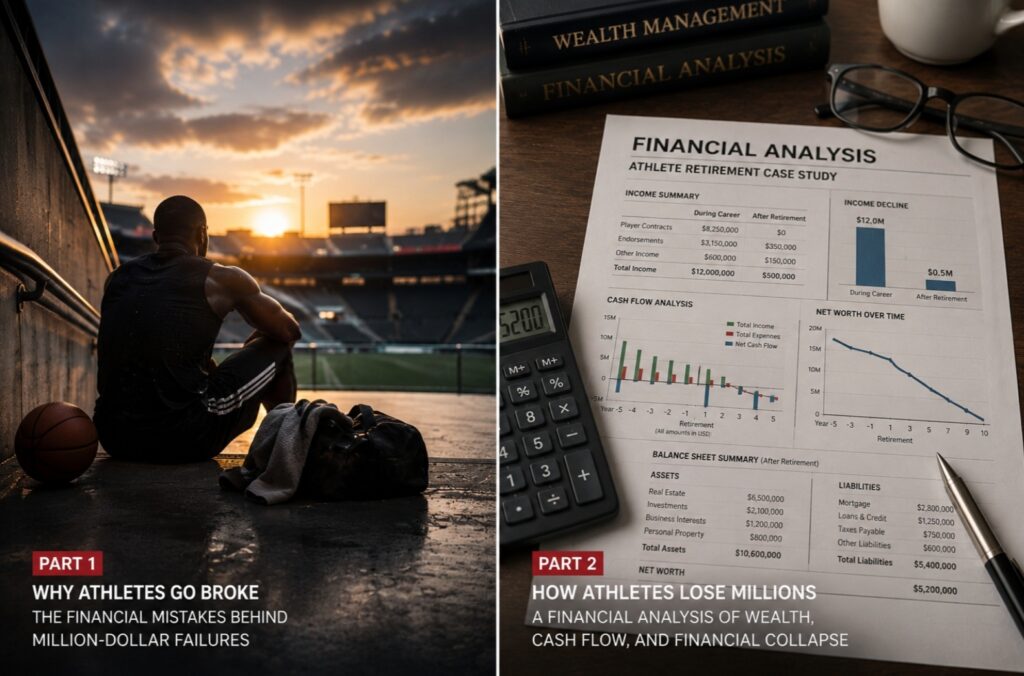
Important Perspective: Most athletes who become broke did not fail because they lacked talent, discipline, or work ethic. Many failed financially because the skills required to become an elite athlete are very different from the skills required to preserve wealth.
The Hidden Reality Behind Athletic Wealth
When fans see a player signing a contract worth $50 million, they often assume the athlete instantly becomes permanently wealthy.
The reality is much more complicated.
The contract amount is usually the largest number associated with the athlete, but it is rarely the amount ultimately retained.
Taxes consume a significant portion.
Agent fees take another percentage.
Professional expenses reduce the remainder.
Family obligations frequently grow.
Lifestyle expectations expand rapidly.
Meanwhile, the athlete is often attempting to build an entirely new life while still managing the intense demands of a professional sports career.
Many athletes experience a financial environment unlike anything most people encounter. Their income rises rapidly, often at a young age, while their experience managing large amounts of money remains limited.
This combination creates enormous risk.
The challenge is not earning the money.
The challenge is keeping it.
The Lifestyle Inflation Spiral
One of the most common reasons athletes lose wealth is lifestyle inflation.
Lifestyle inflation occurs when spending rises alongside income.
At first glance, this may seem reasonable. Higher income naturally allows people to enjoy a higher standard of living.
The problem emerges when lifestyle growth becomes permanent while income remains temporary.
Professional athletes often experience rapid financial success. Suddenly, luxury homes become affordable. High-end vehicles become normal. Private travel becomes routine. Exclusive memberships, designer products, and expensive entertainment become everyday experiences.
Over time, these expenditures stop feeling luxurious and begin feeling normal.
That psychological shift is extremely dangerous.
What once felt extravagant becomes viewed as a necessity.
The athlete is no longer choosing a luxury lifestyle.
The athlete is attempting to maintain what has become their standard lifestyle.
When retirement arrives and income declines dramatically, reducing spending becomes emotionally difficult because it feels like moving backward rather than adjusting to reality.
Many former athletes continue spending according to their peak earning years long after those earnings have disappeared.
The Pressure of Being Everyone’s Financial Hero
For many athletes, success extends far beyond personal achievement.
They often become symbols of hope within their families, neighborhoods, and social circles.
This creates tremendous financial pressure.
Parents who sacrificed for years may finally receive support.
Siblings may need assistance.
Friends may seek investment opportunities.
Community members may expect contributions.
Various causes and charitable efforts may request assistance.
Many athletes genuinely want to help.
The problem is not generosity.
The problem is sustainability.
A successful athlete may gradually become responsible for supporting a large network of people. Individually, each request may seem manageable. Collectively, however, the financial burden can become enormous.
In some situations, athletes find themselves financing lifestyles for dozens of individuals simultaneously.
Once retirement occurs, the expectations often remain even though the income has changed dramatically.
What began as generosity can evolve into a long-term financial obligation that becomes increasingly difficult to sustain.
| Potential Financial Pressure Sources | Long-Term Risk |
|---|---|
| Family Support | Permanent dependency |
| Friend Investments | Poor returns and losses |
| Community Expectations | Continuous financial commitments |
| Personal Guarantees | Future legal obligations |
The Dangerous Illusion That Success Will Last Forever
Human beings naturally assume that current conditions will continue.
This psychological tendency affects everyone, but it can be particularly dangerous for professional athletes.
During their careers, athletes are surrounded by constant reinforcement of success.
The crowds are large.
The media attention is intense.
The contracts continue arriving.
The future appears secure.
However, athletic careers are among the shortest careers in the world.
Injury can end a career instantly.
Performance can decline unexpectedly.
Teams can move on.
Competition from younger players is relentless.
Despite this reality, many athletes subconsciously assume they will continue earning at elite levels for much longer than is realistic.
Financial planning becomes postponed.
Retirement preparation is delayed.
Investment discipline weakens.
Unfortunately, careers often end faster than anticipated.
When that happens, financial preparation may be incomplete.
The Celebrity Spending Culture
Professional sports does not operate in isolation.
Athletes are frequently surrounded by a culture that encourages visible success.
Luxury often becomes part of personal branding.
Expensive possessions become symbols of achievement.
Public perception begins influencing financial decisions.
Some athletes feel pressure to demonstrate success through material possessions because they believe such displays validate their accomplishments.
Others worry that reducing spending might create the impression that they are struggling financially.
As a result, financial decisions become influenced by image management rather than wealth preservation.
The danger is that public appearances can be maintained long after financial reality begins deteriorating.
Many financial collapses occur gradually and remain hidden from public view until they become impossible to conceal.
The Financial Advisor Problem
Contrary to popular belief, hiring financial advisors does not automatically guarantee financial success.
Many athletes rely heavily on professionals to manage their money.
This dependency creates another challenge.
Athletes often possess extraordinary expertise in their sport but limited expertise in finance.
As a result, they must trust others.
Sometimes that trust is well placed.
Sometimes it is not.
History contains numerous examples of athletes losing substantial fortunes due to:
- Dishonest advisors
- Poor investment recommendations
- Fraudulent schemes
- Conflicts of interest
- Incompetent financial management
The athlete may not fully understand what is happening until significant losses have already occurred.
In many cases, the problem is not malicious intent.
It is simply insufficient oversight.
Trust without verification can become extremely expensive.
Financial Lesson: Delegating financial responsibility is not the same as abandoning financial responsibility. Wealth preservation requires understanding, oversight, and accountability.
The Business Venture Trap
Many athletes seek to prepare for retirement by investing in businesses.
This strategy appears logical.
Unfortunately, business ownership introduces a completely different set of risks.
Success in professional sports does not automatically translate into success in entrepreneurship.
Some athletes invest in restaurants.
Others invest in entertainment ventures, technology startups, retail businesses, hospitality projects, or real estate developments.
Many of these investments fail.
The issue is not that athletes should avoid entrepreneurship.
The issue is that entrepreneurship requires expertise, management skills, market understanding, and risk assessment that may be unrelated to athletic achievement.
When large amounts of wealth are invested in poorly understood ventures, losses can accumulate quickly.
The Emotional Shock of Retirement
Retirement is often viewed primarily as a financial event.
For athletes, it is also a profound psychological event.
Many have spent their entire lives pursuing a singular goal.
Their identity becomes deeply connected to athletic performance.
Retirement can create feelings of:
- Loss of purpose
- Loss of status
- Loss of routine
- Loss of community
- Loss of recognition
These emotional challenges can influence financial behavior.
Some individuals attempt to compensate through spending.
Others pursue risky opportunities in search of excitement.
Some delay accepting their new financial reality.
The result is often a series of financial decisions driven by emotion rather than rational planning.
Financial decline frequently accelerates during this adjustment period.
The Absence of Financial Identity
Many athletes dedicate years to developing an athletic identity.
Far fewer develop a financial identity.
They understand how to train.
They understand how to compete.
They understand how to perform under pressure.
But they may never have developed a personal philosophy regarding:
- Wealth preservation
- Long-term investing
- Risk management
- Financial independence
- Retirement planning
Without a clear financial framework, decisions become reactive rather than strategic.
Money arrives.
Money is spent.
Opportunities appear.
Investments are made.
But no overarching plan exists.
Eventually, the lack of direction becomes visible in the athlete’s financial results.
The Real Meaning of Wealth
Perhaps the most important lesson from athlete bankruptcies is that wealth is often misunderstood.
Many people equate wealth with income.
Others equate wealth with possessions.
Still others equate wealth with fame and visibility.
True financial security comes from something different.
It comes from creating a life that remains sustainable after active earning ends.
Athletes who remain financially successful after retirement typically understand this distinction.
They recognize that the goal is not merely earning millions.
The goal is transforming temporary earnings into permanent financial security.
That transformation requires patience, planning, discipline, and a willingness to prioritize long-term stability over short-term appearances.
The Human Side of Financial Collapse
The financial struggles of former athletes are often portrayed as cautionary tales about extravagance or poor choices.
The reality is more nuanced.
Many athletes face challenges few people experience:
- Extreme income at a young age
- Extraordinary public visibility
- Intense social pressure
- Short career windows
- Sudden retirement
- Constant financial requests
- Complex investment opportunities
These pressures create an environment where maintaining wealth becomes far more difficult than outsiders realize.
Understanding these factors helps explain why financial collapse remains so common among individuals who once appeared financially invincible.
In the end, the greatest lesson may be that earning money and keeping money are entirely different skills.
Professional athletes master one of them.
Unfortunately, many never have the opportunity to fully master the other.
Continue Reading (Part 2): How Professional Athletes Lose Millions After Retirement: A Financial Analysis of Wealth, Cash Flow, and Financial Collapse
In Part 2, we move beyond psychology and behavior to examine the accounting and financial mechanics behind athlete wealth destruction, including cash-flow deterioration, asset-liability mismatch, balance sheet weakness, liquidity problems, and the mathematics of long-term wealth preservation.