
U.S.–China trade since China’s WTO entry has produced vast but uneven rewards: American corporations captured high profits by offshoring production to China’s low‑cost labor base while selling into its expanding consumer market, boosting margins and shareholder returns, and giving U.S. consumers cheaper goods. China, meanwhile, gained surpluses, foreign investment, jobs, and rapid GDP growth, transforming into the world’s manufacturing hub. Yet much of the value added and profit flowed back to U.S. firms controlling design, technology, and branding, leaving China with high volume but thinner margins. The imbalance shaped both economies, with capital and consumers benefiting most in America while workers bore losses, and China achieving industrialization and global ascendancy despite limited per‑unit profitability, fueling today’s trade tensions.
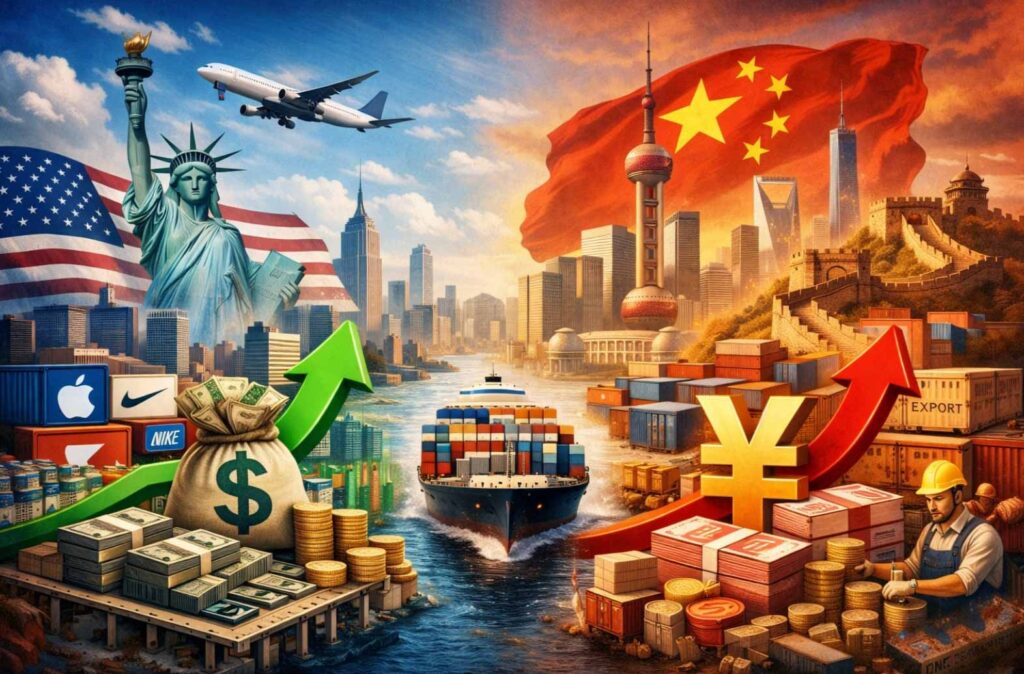
A Two-Way Economic Superhighway
The trade relationship between the United States and China has been a driving force of globalization in the 21st century. Since China joined the World Trade Organization in 2001, bilateral trade in goods surged from just over $100 billion in 2001 to nearly $600 billion by 2024. This exchange transformed supply chains and consumer markets worldwide. For American businesses, China offered both a vast consumer market and an unrivaled low-cost manufacturing base. For China, access to U.S. buyers and investment fueled an export boom that turbocharged its economic growth.
Behind these headline figures lies a nuanced story of gains and imbalances. American capitalists and corporations have reaped substantial profits by leveraging China’s cheap labor and efficient supply chains, often dramatically lowering production costs and boosting their bottom lines. At the same time, China’s economy has achieved enormous revenue growth through exports and attracted foreign investment that built up its industries. The benefits, however, have not been evenly shared or symmetrical. By examining the numbers – from corporate profit margins and trade balances to foreign investment flows and GDP growth – we can see how each side benefited, who may have gained more, and what it means for global economic power.
American Corporations Cash In: Profits from China’s Labor and Market
For many U.S. companies, China has been a goldmine of cost savings and new customers. In the early 2000s, Chinese manufacturing wages were only a fraction of U.S. wages – often less than 5-10% of what an American worker earned for similar factory work. By offshoring production to China or sourcing components there, American firms dramatically cut their costs. Lower production costs meant higher profit margins. In fact, studies show that after China entered the WTO, aggregate profit margins of U.S. firms rose significantly, driven largely by gains from overseas operations. For S&P 500 corporations – the largest U.S. companies – foreign profit margins jumped from around 10% before China’s WTO entry to roughly 15–16% in the following years. This was a huge boost, and much of it can be attributed to accessing low-cost Chinese supply chains and new markets abroad.
Cheap labor and vast supply networks in China allowed U.S. multinationals to increase efficiency. Iconic examples are companies like Apple, Nike, and Walmart: they design and market products at home but have them manufactured in China at a fraction of the cost. The result has been swelling corporate profits. Apple’s iPhone, for instance, is assembled in China, but Chinese labor and components make up only a sliver of its total value. An analysis of the iPhone’s value chain revealed that Chinese firms account for only 2–3% of the final production cost of an iPhone, mostly through assembly. Meanwhile, Apple and other Western technology and component suppliers capture the lion’s share of the profits. For every $100 in profit from an iPhone, roughly $50 goes to American companies (Apple and key chipmakers), around $40 goes to other international suppliers (e.g. Japanese, Korean, Taiwanese firms), and only about $10 in profit stays with Chinese firms. This pattern is echoed across many industries: whether it’s Dell laptops or Nike shoes, U.S. companies profit by controlling design, technology, and branding, while contracting labor-intensive work to China.
Access to China’s vast consumer market has been another boon for American corporations. China’s middle class has grown exponentially, creating demand for everything from iPhones and Buicks to Starbucks lattes. U.S. firms have rushed in to serve that demand. For example, General Motors now routinely sells more cars in China than in the United States, thanks to joint ventures tapping into Chinese auto buyers. Companies like Starbucks and McDonald’s have opened thousands of outlets across Chinese cities. By 2022, it’s estimated that over 70 American companies each were earning more than $1 billion annually in revenue from China, and combined U.S. company revenues in China topped several hundred billion dollars. One analysis found that S&P 500 firms generated roughly $1.2 trillion of revenue within China in a recent year – an amount about four times the U.S. trade deficit with China. These sales contribute to U.S. companies’ growth and, ultimately, shareholder returns back home. In addition, many American manufacturers rely on China as a crucial link in their global supply chain for intermediate goods and components, which keeps their own production competitive and profitable.
American consumers have benefited indirectly as well: importing low-cost goods from China has held down inflation and boosted purchasing power. Shoppers at Walmart or Target have enjoyed cheaper electronics, clothing, and toys “Made in China,” effectively stretching household budgets. Economists estimate that the flood of inexpensive imports from China in the 2000s saved U.S. consumers billions of dollars and dampened price increases. Those consumer savings, however, came at the cost of intense competitive pressure on U.S. manufacturing workers – an asymmetry in how gains were distributed domestically (more on that later). Overall, from the perspective of corporate America and Wall Street, engagement with China has been highly lucrative. U.S. multinational companies saw record profits through the 2010s, and many openly acknowledge that their China operations are critical to remaining globally competitive. Surveys in 2024 show over 80% of U.S. companies in China were profitable, and almost all say they “cannot remain globally competitive” without access to China – whether for its market, its labor force, or its supply base.
China’s Windfall: Export Boom, Investment, and Breakneck Growth
On the other side of the ledger, China’s gains from trade with the U.S. have been transformational. When China opened up and later joined the WTO, it unlocked access to the world’s richest consumer markets and welcomed vast inflows of foreign investment. The result was an export-led growth miracle. Chinese exports of goods exploded from around $266 billion in 2001 to over $3.5 trillion in 2021 – a more than thirteen-fold increase in two decades. The United States became China’s single largest export destination, year after year. By 2022, China was shipping roughly $550 billion in goods to U.S. shores annually, ranging from electronics and appliances to furniture, machinery, and apparel. These exports not only earn China revenue and trade surpluses; they also drove the mass industrialization of the Chinese economy, creating tens of millions of jobs and raising incomes domestically.
Trade has directly contributed to China’s GDP growth and development. In the 2000s, exports often accounted for 30–40% of China’s GDP (goods and services exports were about 36% of GDP in 2006 at their peak). Even as the economy diversified in the 2010s, foreign trade remained a key growth engine. In 2024, for example, net exports contributed about 30% of China’s GDP growth, as export volumes surged while imports lagged. By integrating into global markets, China sustained an average of ~10% annual GDP growth for three decades. Its GDP vaulted from just $1.2 trillion in 2000 to over $17 trillion in 2023, making China the world’s second-largest economy (and the largest by purchasing power parity). Trade with America was a huge part of that story – the U.S. appetite for Chinese-made goods powered factory output from Shenzhen to Shanghai, lifting China’s national income and government tax revenues.
Trade surpluses with the U.S. became a regular feature of China’s economy. Year after year, China sold far more to America than it bought, resulting in a large surplus on China’s side (and a corresponding deficit for the U.S.). In 2001, China’s surplus with the U.S. was around $83 billion; by 2018 it hit a peak of over $380 billion. Even after some trade war tariffs and shifts in supply chains, the imbalance remains huge – China’s surplus in goods with the U.S. was about $404 billion in 2022, and eased slightly to $361 billion in 2023 (still the largest bilateral trade surplus in the world). These surpluses mean China earns hundreds of billions of dollars more from trade each year than it spends, accumulating wealth in the form of foreign exchange reserves. By 2014, China’s central bank had amassed nearly $4 trillion in reserves (much of it invested in U.S. Treasury bonds), a financial war chest directly linked to years of trade surpluses. As of 2024, China’s global trade surplus (with all countries) was almost $1 trillion in a single year – an astonishing reflection of its status as the “world’s factory.” This surplus savings has allowed China to invest aggressively in infrastructure at home and projects abroad, and to maintain a stable currency.
Importantly, foreign direct investment (FDI) has been another channel of gain for China. American and other Western firms have poured capital into building factories, R&D centers, and businesses in China. U.S. FDI in China reached a cumulative stock of about $127 billion by 2023 (per U.S. government data), and that understates the total influence if you include investments routed through Hong Kong or other countries. These investments brought not only money but also technology and managerial know-how. For example, American automakers set up joint ventures that introduced modern car-making techniques; tech companies set up production with cutting-edge processes. Chinese workers gained skills and higher wages, and local suppliers learned to meet international standards. Over time, China leveraged these investments to climb the value chain – starting with toys and textiles, moving into electronics assembly, and now producing advanced products like smartphones, solar panels, and even passenger jets. The presence of global companies also spurred the growth of China’s own private firms that could become suppliers and later competitors. The net effect was to accelerate China’s industrial modernization by perhaps decades.
Millions of Chinese citizens directly benefited through employment and rising incomes thanks to trade. Coastal manufacturing zones boomed as exporters grew. The flood of job opportunities led to the largest urban migration in human history: hundreds of millions moved from rural villages to city factories. Wages in manufacturing steadily rose (roughly 10–15% increases per year for much of the 2000s and 2010s), lifting many families into a new middle class. Export industries became an on-ramp out of poverty for generations of Chinese workers – a key reason why China was able to lift over 800 million people out of extreme poverty since the late 1970s. And as Chinese companies grew via exports, some became globally competitive in their own right (e.g. companies like Huawei, Lenovo, and Haier emerged, initially building on export success).
In summary, trade with the U.S. provided China with a massive market to fuel its factories, a source of capital and tech via investment, and a steady inflow of hard currency. It helped transform China from an agrarian low-income nation into the manufacturing powerhouse of the world. By the 2020s, China was producing nearly half of the world’s manufactured goods by some measures, and its economy had swelled to rival the U.S. in size. However, the benefits China accrued were not without caveats – and when we dig deeper into the distribution of gains, a striking asymmetry appears.
Asymmetries and Imbalances: Who Benefited More?
While both sides have gained from U.S.–China trade, the nature and distribution of those gains have been highly uneven. A popular phrase captures this dynamic: “The surplus stays in China, but the profits end up in the U.S.” In other words, China may have a large trade surplus (exporting far more than it imports), but the value-added and profit margins on many of those exports are relatively low, with much of the true economic value captured by American firms upstream or downstream.
To understand this, consider how global supply chains work. Many Chinese exports are assembled products or intermediate goods that include components from various countries. For example, a “Made in China” smartphone might contain chips from the U.S., memory from South Korea, and a display from Japan, all put together by a Chinese factory. Traditional trade statistics credit the entire $500 phone as a Chinese export, but in value-added terms China might only earn $30 of that (mainly assembly wages and local inputs), while foreign suppliers and the American brand capture the rest. This means China’s headline trade surplus is somewhat misleading as a gauge of true economic benefit.
Indeed, research on Trade in Value Added (TiVA) finds that the domestic Chinese content in exports to the U.S. is far lower than the gross export value. U.S. demand accounts for only about 3% of China’s total GDP output when measured in value-added terms, despite the huge export numbers. This indicates that a lot of the export earnings circle back out to pay for imported components or accrue as profits to foreign intellectual property holders. High-tech and high-profit parts of the chain – chip design, software, branding – are often dominated by U.S. or other multinational firms, which ensure the biggest profits flow back to them. That’s why America can run a $300+ billion trade deficit with China yet American companies (and investors) still come out very well financially. It also helps explain why, despite China’s manufacturing might, U.S. companies remain more profitable on average than Chinese companies. (For instance, in recent Fortune Global 500 rankings, U.S.-based firms collectively earned roughly double the profits of China-based firms, even though Chinese firms match or exceed them in revenue. The profit margins are higher for the American firms.)
From China’s perspective, the trade surplus brings benefits – factories humming and workers employed – but profits per unit can be slim. Many Chinese factories operate on razor-thin margins as contract manufacturers. A huge volume of exports (and resulting GDP) doesn’t necessarily translate into equivalent corporate profits in China. In fact, a significant share of China’s export sector is foreign-invested firms or joint ventures, which repatriate part of their profits. Even the massive foreign exchange reserves China accumulated by running surpluses have mostly been invested in low-yield assets like U.S. government bonds. This arrangement has sometimes been analogized as China lending savings back to the U.S. at low interest, which in turn finances U.S. consumer purchases of Chinese goods – a circular flow that favored U.S. consumers and government finances.
Another asymmetry lies in who within each country benefits. In the U.S., the gains from China trade have accrued disproportionately to capital over labor – meaning shareholders, corporate executives, and consumers benefit, while many workers in certain sectors lost out. The influx of Chinese imports, combined with offshoring, led to painful disruption in American manufacturing communities (often termed the “China Shock”). Between 2001 and 2010, an estimated 2–3 million U.S. manufacturing jobs were lost or displaced due to import competition and factory relocations tied to China. While cheaper goods and higher corporate profits boosted overall U.S. economic welfare slightly, those gains were unevenly distributed – lower prices benefit everyone a bit, but job losses hit specific workers hard. Over time, the U.S. economy adjusted: new jobs arose in services and high-tech fields, and the Federal Reserve’s low interest rates (partly enabled by China recycling surplus dollars into U.S. Treasuries) spurred growth. Yet the political backlash in recent years – calls for tariffs, “bringing jobs back,” etc. – reflects how the benefits to American companies and consumers came at a visible cost to industrial workers. The term “American capitalists” is apropos: it was largely the owners of capital (investors) who profited from the arbitrage of paying lower wages abroad and selling to the U.S. market.
In China, the distribution of gains also had its complexities. The opening to trade created a new urban middle class and immense wealth for some entrepreneurs, but it also exacerbated inequality between coastal export hubs and the inland rural areas (at least in the early years). Factory workers in China initially earned very low wages – which was the very attraction for foreign firms – and worked long hours. Over time wages rose, yet by global standards Chinese labor has remained cost-competitive due to improvements in productivity and infrastructure. The Chinese government often intentionally accepted lower profit margins in export industries as a trade-off for achieving industrialization and employment. Local governments offered tax breaks and cheap land to export firms, keeping costs low. As a result, a sizable chunk of the value created in China’s export boom was effectively transferred to foreign consumers (through low prices) and foreign companies (through outsourced profits). This was not without benefit – it achieved rapid GDP growth and technological catch-up for China – but it meant that for many years China’s role was that of the high-volume, low-margin producer in the global economy.
One clear illustration of asymmetry is the services trade: the U.S. consistently runs a services trade surplus with China (about $30–$40 billion annually in recent years). American firms and institutions earn billions from Chinese students studying at U.S. universities, Chinese tourists traveling to America, and Chinese companies paying for U.S. intellectual property licenses, financial services, and software. These are high-value exports that boost U.S. incomes. China, by contrast, has a deficit in services with the U.S., reflecting its lesser development in those high-profit areas. This again tilts the overall profit distribution toward the U.S., even as China might sell more physical goods.
To sum up, China’s gains have been enormous in scale – in jobs, output, and world market share – but much of the monetary value and profit from U.S.–China trade has ultimately flowed back to the United States (to U.S. companies, innovators, and consumers). In pure economic welfare terms, some economists argue the U.S. actually benefited more overall from China trade when you account for consumer savings and corporate gains, even though China obviously saw faster GDP growth. However, those U.S. benefits were diffuse and often invisible (cheaper goods, higher stock prices), while the costs (factory closures) were concentrated and painful, leading to a perception that “China won at America’s expense.” There is truth in both perspectives: China “won” in terms of development and global ascendancy, and American businesses “won” in terms of profits – while certain communities in the U.S. lost out. The asymmetry in who benefits underpins much of the tension we see today.
Historical Context: From Cooperation to Competition
Historically, the U.S.–China trade relationship was once viewed as mutually beneficial and complementary. In the late 1990s and early 2000s, U.S. policymakers and corporations largely supported China’s integration into the global trading system. The logic was straightforward: Americans would get affordable consumer goods and new markets for exports (like Boeing jets and Midwest soybeans), while Chinese people would get jobs and rising living standards – a “win-win” under globalization. For a while, this held true. China’s WTO entry in 2001 unleashed a wave of U.S. corporate investment in China and a surge of imports into the U.S. Consumer prices in the U.S. stayed low through the 2000s, and U.S. inflation was notably subdued, in part thanks to inexpensive imports. Meanwhile, U.S. exports to China also grew (China became a top 3 market for U.S. farmers and companies like Caterpillar and Qualcomm).
However, by the mid-2000s the imbalances became hard to ignore. The U.S. trade deficit with China ballooned every year, and China’s cumulative surpluses translated into growing financial clout (as seen in its towering forex reserves and ability to invest overseas). Moreover, China’s rapid development meant it started moving into more advanced industries, stirring anxiety about technological leadership. American manufacturers complained about unfair competition, citing China’s low wages, but also subsidies, intellectual property violations, and currency policies that kept the yuan undervalued in the 2000s. These factors contributed to making Chinese exports artificially cheaper, critics argued. The phrase “China shock” entered the lexicon as economists documented the severe impact on certain U.S. regions – factory towns in the Midwest and South were devastated by factory relocations or import competition. It became evident that while the nation as a whole grew richer, the distributional downsides were real and not adequately addressed by policy (few efforts were made to help displaced workers retrain or relocate).
By the 2010s, the tone had shifted toward rivalry. China had become the world’s #1 exporter and a rising high-tech power, and the U.S. began to view it as a strategic competitor. The trade relationship, once seen as a bridge of cooperation, increasingly looked unbalanced and fraught with conflict. In 2018, the U.S. launched a trade war, slapping tariffs on hundreds of billions of dollars of Chinese goods to pressure Beijing on issues like the trade deficit, intellectual property theft, and market access barriers. China retaliated with its own tariffs on U.S. goods. The result was a spiraling of tensions, which highlighted how economically intertwined yet adversarial the two powers had become. Even after some tariffs and export restrictions, the core trade flows persisted (Americans still import vast quantities from China, and China still needs certain U.S. technologies and agricultural products). However, both sides have since taken steps to diversify and reduce dependence on each other in critical areas. The U.S. is promoting “re-shoring” or “friend-shoring” of supply chains (bringing manufacturing back or to allied countries), especially for semiconductors and medical supplies. China, for its part, has a “dual circulation” strategy to boost domestic consumption and become self-sufficient in tech, to rely less on the U.S. market and inputs.
This historical journey from enthusiastic engagement to cautious partial decoupling underscores how the perception of uneven gains can alter political attitudes. Early on, China was seen as benefiting hugely in growth (which it did), while the U.S. was seen as suffering manufacturing decline. Later, analyses pointed out that U.S. corporations were profiting handsomely, even as some American workers suffered – a nuance often lost in public debate. Now, both countries are reassessing the balance of benefits and risks from their trade ties.
Consequences for Global Economic Power and Future Relations
The divergent gains from U.S.–China trade have had profound consequences for global economic power dynamics. On one hand, trade integration helped China rise from a minor economy to a superpower. It is now the manufacturing workshop of the world, the largest trading nation, and a major source of global capital. The wealth and technology China accumulated via trade have enabled it to invest in cutting-edge industries (like 5G, electric vehicles, and aerospace) and to extend its influence abroad through initiatives like the Belt and Road (funded in part by its trade surpluses). China’s export-led ascent shifted the center of gravity of industrial production and has challenged the West’s long-held dominance in some sectors. In a few decades, China moved up from making t-shirts and toys to producing high-speed trains, advanced smartphones, and potentially world-class commercial aircraft. This climb is eroding the earlier asymmetry of value capture – China is striving to capture more of the profit by developing its own brands, technologies, and service sector, instead of just being the low-margin assembler for foreign firms. If successful, this would tilt the balance of economic power even further toward Beijing as it keeps more value at home.
On the other hand, the United States has, somewhat counterintuitively, reinforced certain strengths through the trade relationship. American companies leveraged Chinese efficiency to become more competitive globally, often dominating the design, innovation, and marketing side of business while contracting out the less profitable manufacturing portion. This specialization allowed the U.S. to focus on high-value activities – think Silicon Valley R&D, Hollywood content creation, advanced financial services – many of which the U.S. leads in and which generate huge profits. The influx of affordable imports also freed up consumer spending power and helped keep U.S. interest rates low (as China invested its dollar surpluses in U.S. bonds). These factors contributed to a long economic expansion and booming asset markets in the U.S., solidifying America’s financial hegemony. Wall Street, for example, benefited from globalization with China as U.S. corporate earnings swelled and capital flowed freely. Moreover, the U.S. continued to attract talent and investment, partly because its companies were at the forefront of the global economy, bolstered by global supply chains that included China.
In terms of global influence, the U.S. still maintains an edge in critical areas: the dollar remains the world’s dominant currency (a status unshaken even by China’s large reserves), American firms are among the most profitable and innovative, and the U.S. sets a lot of the rules in international finance and technology standards. However, China’s new wealth and scale mean it increasingly dictates terms in manufacturing and trade arrangements. For many countries, China is now the top trading partner, aid provider, or investor, which expands Beijing’s geopolitical sway. The U.S.–China trade relationship is thus not just bilateral; it is at the heart of how the entire world economy is organized. When it is running smoothly, it drives global growth; when it falters (as during the trade war or the pandemic supply disruptions), it sends shockwaves worldwide.
Looking to the future, we face a pivotal question: Will this trade partnership remain a source of mutual (if uneven) gain, or will it fracture under strategic competition? Both nations are now keenly aware of the vulnerabilities in being too interdependent. The U.S. worries that relying on China for key materials (like rare earth metals or pharmaceutical ingredients) could undermine national security or that China’s technological rise might threaten American leadership. China worries that the U.S. could cut off its access to crucial technology or markets (as seen when the U.S. imposed export controls on advanced semiconductors), potentially stifling China’s growth. These concerns are pushing both towards partial decoupling: diversifying supply sources, bringing production back home or to friendly nations, and developing indigenous capabilities.
However, a complete divorce is unlikely in the near term given the deep economic linkages. Trillions of dollars of trade and investment still bind the two. The challenge will be managing this relationship so that it remains beneficial but also fair and secure. We may see a future where trade continues but is more selective: non-sensitive goods and everyday consumer products might still flow freely (maintaining many of the mutual gains), while sensitive high-tech sectors are cordoned off for nationalistic reasons. Each side will also try to maximize its own value capture – the U.S. by safeguarding its innovation edge and China by moving up the value chain and building global brands.
One broader consequence is that global economic governance may shift. China, flush with export-derived capital, has set up new international institutions (like the Asian Infrastructure Investment Bank) and increased its voice in organizations like the WTO and IMF. The U.S.–China trade tussles could set precedents for how trade rules are enforced or re-written. If the two giants find a cooperative framework – perhaps updating trade agreements to address issues like intellectual property, market access, and labor standards – it could strengthen global trade norms. If they remain at odds, the world could split into rival trading blocs, reducing efficiency and growth for all.
For other countries, the U.S.–China trade asymmetry was a mixed blessing: many nations (like Germany, Australia, South Korea) benefited by selling raw materials or components into China’s production machine and by enjoying cheap Chinese goods via U.S. consumers. But they also felt competitive pressure as China climbed into higher-value exports. Going forward, those countries are watching closely. The broader balance of economic power in the 21st century will heavily depend on how the U.S. and China manage their trade and investment ties.
Will China eventually capture the same high profit margins that U.S. firms do, or will it remain, in effect, the surplus generator fueling others’ profits? Can the U.S. retain its innovative edge and consumer-driven gains without hollowing out its industrial base? These questions remain open. What is clear is that both nations gained immensely from their trade – but in very different ways. The U.S. gained cheaper goods, stronger corporations, and global financial dominance; China gained industrial capacity, jobs, and a fast track to great-power status. Each also paid certain costs for these gains. The asymmetry in benefits contributed to mistrust, yet the interdependence also acts as a restraint – neither side can easily afford to sever ties without harming itself.
Navigating a New Phase of U.S.–China Trade
U.S.–China trade has always been about more than just economics; it has been a grand experiment in global integration that lifted millions from poverty, reshaped industries, and tested how two very different nations could both prosper. The profits amassed by American companies and investors thanks to China have been enormous, as have the developmental dividends that trade delivered to China. However, the experience has also revealed stark asymmetries. China amassed trade surpluses, yet much of the value and profit looped back to the U.S., reinforcing American economic strengths. That imbalance – surplus vs. profit – is at the core of why perceptions of the relationship differ.
From an American standpoint, big businesses and consumers were clear winners, while some workers were losers. From a Chinese standpoint, the nation achieved rapid growth and poverty reduction, but often by doing the heavy lifting at modest reward, while foreign capital reaped high returns. These subtleties are often lost in political narratives, which prefer simpler stories of one side “winning” and the other “losing.” In truth, both won – and both have grievances.
As we enter the next chapter, the task will be to rebalance and update this relationship. That could mean China consuming more and relying slightly less on exports, which would reduce its surpluses. It could also mean the U.S. rebuilding some domestic capacity or insisting on fairer trade practices so that the benefits of trade are more broadly shared at home. Ideally, future trade relations can be managed through negotiated rules that address technology transfer, intellectual property, and market access issues, rather than through destructive tariffs alone.
If U.S.–China trade can be steered toward a more sustainable and equitable footing, it will remain a cornerstone of global prosperity. The combined economic might of these two countries – they together account for over 40% of world GDP – means their cooperation or conflict reverberates worldwide. The story so far shows the incredible potential of cooperation (skyrocketing growth and profits) and the pitfalls of imbalance (domestic discontent and strategic rivalry).
The overarching lesson is that trade is not a zero-sum game, but neither are its gains automatic or equal. How those gains are distributed matters for economic and political stability. The U.S.–China trade saga, with all its trillions of dollars of exchange, is a case study in both the power of globalization and the need to manage its outcomes. Going forward, a key question will be whether the two nations can acknowledge the asymmetries and work to correct course – finding a new equilibrium where China can climb the value ladder without feeling exploited, and the U.S. can trade with China without gutting its middle class. The answer will shape the balance of global economic power for decades to come.
In the end, the “surplus in China, profit in America” paradigm may evolve. China is striving to capture more profits at home, and the U.S. is keen to produce more critical goods domestically. Yet completely uncoupling is neither feasible nor desirable economically. A likely outcome is a more selective engagement: continuing the mutually beneficial aspects (so both economies keep growing) but negotiating a fairer distribution of benefits and guarding against excess dependence in sensitive sectors. Achieving that balance could ensure that U.S.–China trade remains a source of stability and prosperity, rather than a point of contention.
The stakes are high. The past few decades proved that when the world’s two largest economies trade, the whole world can win – but also that the terms of trade matter profoundly. As we navigate this new phase, understanding the gains and gaps in the U.S.–China trade relationship is crucial. It’s not about being pro-China or anti-China, but about recognizing how deeply intertwined their fortunes are, and how carefully that relationship must be managed so that the rewards of trade are shared and sustainable. The future of globalization, and indeed global economic leadership, will hinge on how these two giants manage the next chapter of their economic entwinement.