
In the digital age, many employers are using advanced technology to monitor their workforce. This ranges from simple CCTV cameras in office hallways to complex software tracking keystrokes, screen time, and even emotions. A U.S. government report notes that modern “bossware” tools cover a wide spectrum – including cameras, microphones, computer-monitoring programs, GPS trackers, app analytics, and wearable health sensors – across industries like warehousing, retail, trucking, healthcare and finance. (See illustration below.) Employers often cite security, productivity, and compliance as reasons for such surveillance, but critics warn these practices may erode privacy, trust, and worker wellbeing.
Fig: Digital surveillance tools used in workplaces. Cameras, microphones, software, GPS and wearable sensors are increasingly used to track employee activity and productivity. According to U.S. analysts, this broad “range of digital surveillance tools” is employed in nearly all types of workplaces. In offices and factories, cameras and screen-monitoring software can record workers’ actions and computer use. In transportation and logistics, GPS devices and onboard cameras track vehicle routes and drivers’ behavior. In retail and warehouses, scanners and apps log each task, while even employee health data (like heart rate or sweat levels) may be collected via smart badges or wearables. All told, employers can monitor work emails and chats, keyboard use, program usage, location, time on tasks, and even physiological data – often automatically and continuously.
Types of Surveillance Tools. Modern workplace surveillance includes:
- Digital tracking software: Programs like Teramind, Hubstaff or ActivTrak can capture employees’ keystrokes, take periodic screenshots of their computers, and log which applications or websites they use. For example, one firm’s employee analytics software gave automated “tips” such as “Not enough time in the Zone” when workers spent little time at their desks. Web and email activity on company devices is generally considered fair game; indeed, U.S. law (the Electronic Communications Privacy Act) allows employers to view stored emails or social media usage on company computers without violating privacy protections.
- Cameras and microphones: Surveillance cameras in offices, stores or warehouses record video (and sometimes audio) of workers. Employers may install CCTV to prevent theft or ensure safety, but these cameras can also track employee movements and interactions. A GAO report notes that cameras (and microphones) are among the most common “bossware” tools. (For instance, warehouse workers at Amazon report being videotaped nearly everywhere on the job.) Some companies have even experimented with audio sensors: in 2018 Walmart patented a system of microphones aimed at capturing sounds (beeps, conversations, greetings) on the salesfloor to generate “performance metrics” for cashiers. (This plan drew criticism because it could run afoul of state laws requiring two-party consent for recordings.)
- Keystroke logging & webcam access: Beyond passive observation, employers sometimes enable active surveillance of computer input and even the worker’s face. Keystroke logging software records every key tapped on a keyboard. Employers may also require remote workers to leave their webcams on during work, allowing managers to visually confirm presence or check workspace conditions. A notable example involved an Australian firm (Safetrac) which secretly used monitoring software that turned employees’ laptop webcams and microphones into listening devices during work hours. The outcry over such practices highlights how invasive always-on monitoring can feel.
- Location and movement tracking: Many companies equip employees with ID badges or apps that track location. In transportation and delivery businesses, vehicle GPS devices record routes and stops. Even in offices, badge swipes or Wi-Fi logins can pinpoint which areas workers enter and when. Some firms use “geofencing” apps on company smartphones to ensure remote workers remain within an approved work area. (Note that some jurisdictions restrict this: for example, California requires employee consent for off-duty GPS tracking.)
- Biometric and physiological monitoring: Some workplaces collect biometric data for security or efficiency. This includes fingerprint or facial recognition for building access, retina scans, or wristbands that monitor heart rate and stress levels for safety (e.g. to detect fatigue in hazardous jobs). Under laws like the EU’s GDPR, such biometric identifiers are classified as special category data, requiring strong justification and safeguards.
- AI and analytics: Newer surveillance uses artificial intelligence to analyze data automatically. Examples include software that scores each employee’s productivity based on multi-factor data (computer use, files accessed, messages sent), or AI that reads camera footage to identify whether workers seem inattentive or upset. Some HR teams even use predictive analytics on employee communications or social media to flag who might quit soon. These AI-driven systems are often opaque (“black boxes”) and raise concerns about bias. Indeed, an EU proposal (the AI Act) specifically bans AI systems from inferring emotions or “categorizing people” by sensitive traits in the workplace.
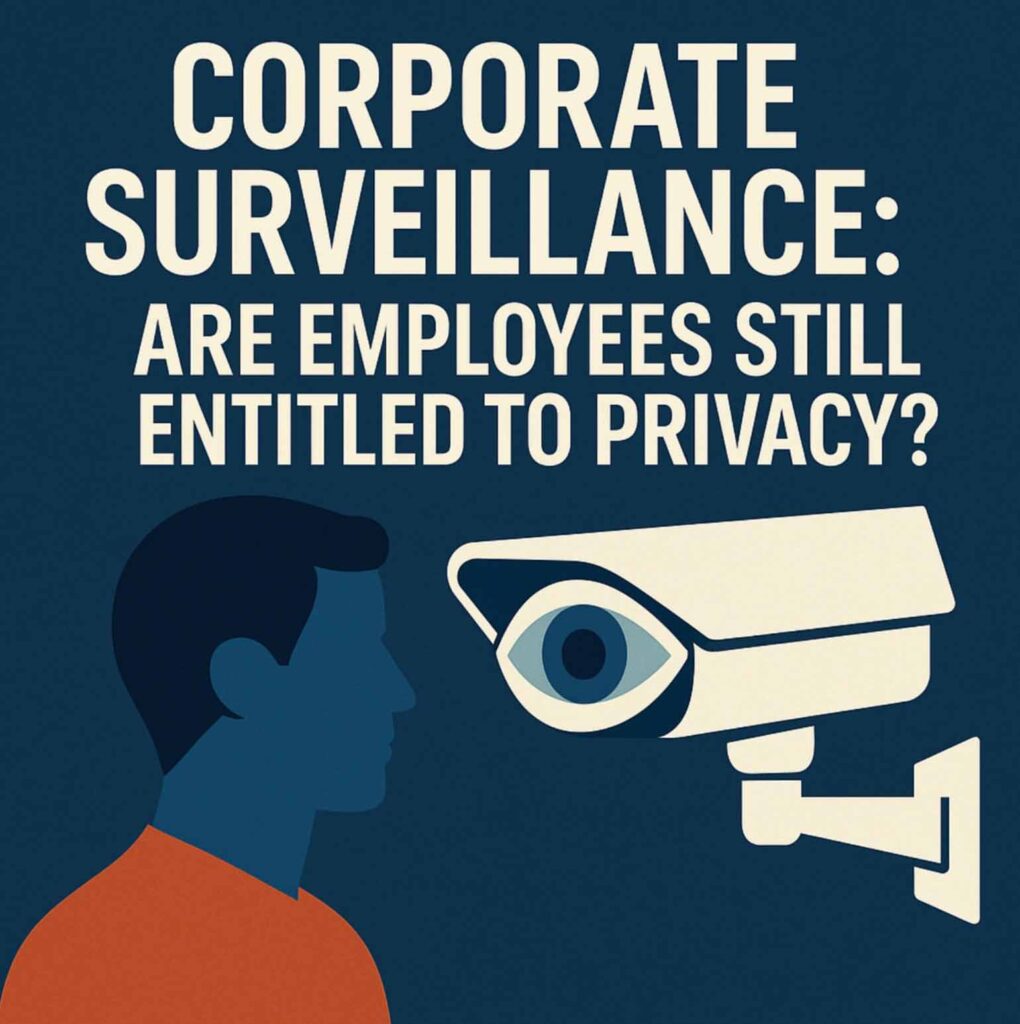
Fig: Overhead surveillance camera in an office. Employers may use CCTV cameras in open-plan offices and common areas to continuously monitor employees’ movements. A U.S. watchdog report notes that such cameras (along with microphones and digital trackers) form the core of modern “bossware,” enabling 24/7 observation of workers. While a business may justify cameras for security or safety, placing hidden cameras in private areas or monitoring without notice can violate employees’ reasonable expectation of privacy.
Surveillance Across Industries
Surveillance practices can vary by industry, though similar tools often appear in many sectors. Here are a few examples from recent reports and studies:
- Technology and IT: Tech companies often monitor digital activities closely. Some software firms track engineers’ code commits, meeting attendance, or online collaboration. During the COVID-19 shift to remote work, many tech firms added monitoring. For instance, Microsoft Teams introduced features to detect whether employees are “at work” or how much time they spend on call. Tech firms also analyze email and chat logs for security threats. (Note: details on specific tech companies are often proprietary, but industry surveys suggest a majority of tech firms use monitoring software for remote staff.)
- Financial Services: Banks and financial institutions have long used monitoring to ensure compliance and security. For example, Barclays faced public backlash when it was revealed in 2020 that it had placed motion sensors under employees’ desks (the OccupEye system) to measure time spent at workstation and bathroom breaks. These sensors triggered onscreen messages like “Not enough time in the Zone,” pressuring workers to minimize breaks. The UK Information Commissioner’s Office warned Barclays that workers are “entitled to some privacy” even at work, and that “monitoring outside of working hours” is especially sensitive. Many banks also monitor all email, phone calls, and instant messages on their networks for insider trading or confidentiality breaches.
- Retail and Warehousing: Large retailers and logistics companies heavily monitor staff. Amazon is a prime example: its warehouses use scanners that record each item workers handle, tracking how many items are scanned per hour and flagging “inactivity” as a slow-down. In 2024 Amazon France was fined €32 million for retaining excessive surveillance data from 20,000 employees, including requiring workers to justify every break. In another case, U.S. Amazon workers filed NLRB charges alleging the company used “intrusive algorithms” to detect union organizing. (Workers report being tracked everywhere in the fulfillment center – by overhead cameras and screen-based dashboards that show managers when an employee pauses.) Beyond Amazon, other retailers like Walmart have experimented with audio analytics (see patent above) and regularly monitor store surveillance footage.
- Manufacturing and Warehousing: Factories and warehouses use a mix of cameras, RFID trackers, and IoT sensors. In warehouses, forklifts and conveyor belts may have sensors to log productivity, and wearables may monitor ergonomics or fatigue. In manufacturing plants, supervisors might watch live video feeds or review CCTV for safety and efficiency. (An example: Airbus monitors assembly-line workers via cameras to ensure they follow protocols.) Factory floors increasingly use computer vision: for instance, one hotel chain uses wearable panic-buttons and GPS-enabled devices for housekeeping staff facing guest harassment.
- Healthcare: Hospitals and care facilities are subject to strict privacy rules (HIPAA in the U.S.) which limit what patient data can be accessed. However, hospitals still use monitoring for staff. This can include ID-badge tracking of who enters operating rooms, electronic logging of when nurses administer medication, and CCTV in public areas for security. If telehealth workers work remotely, employers may similarly track their computer use or VPN connections. Notably, any employee monitoring in healthcare must be careful not to log or expose Protected Health Information of patients.
- Service and Gig Economy: Call centers routinely record or listen to employee calls for quality control, often without the caller’s knowledge. Gig platforms (Uber, Lyft, Deliveroo) track drivers via GPS for routing and performance ratings. Even in education, some universities use proctoring software that cameras and tracks students – though that is students, not employees.
In short, almost every sector sees some level of monitoring. Surveys indicate the trend is widespread: for example, 43% of U.S. remote/hybrid employees reported their online activity was monitored by their employer. Industries that value security (finance, tech, government) or deal with sensitive data tend to justify more surveillance, but no private sector is immune from the surveillance wave.
Remote, Hybrid and In-Office Monitoring
The rise of remote and hybrid work has dramatically changed how surveillance is deployed. When employees are working from home, the office walls no longer constrain oversight – employers can install monitoring software on laptops and mobile devices to replicate some aspects of in-person supervision.
- Remote work monitoring: In a remote setting, software tools can log hours active, track internet usage, take periodic screenshots, or even require employees to take webcam selfies to prove they are at their desk. One survey found almost half of companies were monitoring remote employees’ computer activity, including sites visited and applications used. Employers sometimes set up chatbots to ping remote workers if they appear inactive. During the COVID-19 pandemic, many firms rapidly adopted these tools; for example, a survey of executives found that within weeks of the pandemic lockdowns, 16% of financial firms had bought new monitoring software licenses for their staff.
- In-office monitoring: In the physical workplace, tools are more traditional. This includes badge swipe records, CCTV cameras in corridors and break rooms, monitoring of landline calls (subject to wiretap laws), and physical security checks. In-office, some employers may still use software tools (especially on company devices or in offices with hot-desking) to log computer usage. For on-site factory workers, surveillance may be via on-floor supervisors with tablets, CCTV, or vehicle telematics. Importantly, in many jurisdictions employees have a stronger expectation of privacy in certain locations at work: for example, hidden cameras in bathrooms or listening devices in private offices are prohibited.
- Hybrid environments: Many organizations now blend both. A hybrid model might use office cameras and badge systems when people come in, plus the same remote-monitoring software when they work from home. Employers may require home Wi-Fi configurations (trusted networks) or use virtual desktops that keep work activity on company servers. The result is that the coverage of surveillance can follow an employee between home and office. Workers report feeling “always on” – one survey found 32% of monitored employees had no clear notice of the surveillance program despite significant impacts on morale.
Regulatory responses to remote monitoring have started to appear. For example, several EU countries have updated telework laws: Greece now forbids using webcams to monitor remote workers’ performance; Portugal requires employers to inform remote employees of the nature and use of any monitoring devices or programs; Cyprus bans webcam surveillance for performance evaluations. These laws recognize the heightened privacy issues when employees use their homes for work. In the U.S., some states have started to legislate on workplace tech – for instance, Washington state passed a “Workplace Privacy Act” requiring employee consent or council oversight for monitoring, though broad federal rules are still lacking.
Legal Frameworks in Europe and the U.S.
Employee monitoring raises complex legal questions, and the rules differ substantially between Europe and the United States.
European Union
In the EU (including the U.K., which follows similar rules), worker surveillance must comply with data protection and privacy laws. The cornerstone is the General Data Protection Regulation (GDPR), which treats any monitoring of employees as processing of personal data. Key requirements under GDPR include:
- Lawful basis and necessity: Employers must have a lawful basis (usually “legitimate interest”) for processing employee data, and they must balance their interest against workers’ privacy rights. For intense surveillance – like continuous tracking – many data protection authorities demand that monitoring be strictly necessary and proportionate to a legitimate aim (e.g. security, health, or legal compliance). In practice, this often means that using aggregated or anonymized data is favored, and that invasive monitoring (like constant audio recording) requires very strong justification. Consent from employees is usually not a valid basis in the EU, since consent must be freely given; in an employer-employee relationship, consent is considered coerced.
- Transparency and data minimization: Employers must inform employees in detail about any monitoring: what data is collected, how it is used, how long it is retained, and with whom it is shared. The GDPR’s principles of “data minimization” and “purpose limitation” mean that employers should collect only what’s needed (e.g. tracking task completion rather than personal browsing history) and cannot use data for unrelated purposes without new notice. However, compliance is hard: digital tools often collect large volumes of data and use opaque algorithms. EU guidance and court cases stress that surveillance resembling “continuous and detailed tracking of employees’ activities” can significantly infringe privacy rights, and should be avoided unless absolutely necessary.
- Worker consultation: Beyond GDPR, EU labor law and social dialogue rights also play a role. The EU’s Works Councils Directive (2002/14/EC) generally requires informing and consulting employee representatives on “substantial” changes in work organization. Many national laws interpret new monitoring technologies (like AI management systems or widespread CCTV) as substantial changes that require advance notice or negotiations with works councils. For example, countries like Germany, France, Spain and the Netherlands grant works councils the right to approve or at least be informed about new surveillance systems. In Spain, the Data Protection Act specifically limits video surveillance and mandates consultation before installing tracking devices in workplaces. In short, EU practice strongly encourages (or mandates) involving workers or their representatives when introducing monitoring.
- Other EU instruments: The ePrivacy Directive (and its future replacement, the ePrivacy Regulation) adds confidentiality rules for communications. Generally, it prohibits intercepting private communications (phone calls, emails) without consent. In the workplace context, this means an employer usually needs notice before eavesdropping on calls or decrypting messages. For audio/video monitoring, many EU countries require that at least one party knows about the recording. The European Court of Human Rights has also weighed in: its decisions affirm that indiscriminate workplace surveillance can violate the right to privacy under Article 8 of the European Convention on Human Rights.
- EU AI Act (forthcoming): A new development is the EU Artificial Intelligence Act, which will specifically regulate AI systems. The draft law bans particularly invasive AI in the workplace – for instance, it forbids AI that infers emotions or psychological states from workers’ data, or that categorizes them by sensitive traits. High-risk AI applications (like those for employee hiring or performance evaluation) will require rigorous self-assessments and transparency before use. These measures, once implemented, should impose additional safeguards on AI-driven monitoring in Europe.
United States
By contrast, U.S. law has no single, comprehensive workplace privacy statute. Privacy in employment is addressed by a patchwork of federal and state rules, and largely by common law (tort) principles:
- Federal laws: The main federal statute that limits workplace surveillance is the Electronic Communications Privacy Act (ECPA) of 1986. ECPA prohibits interception of “wire, oral, or electronic communications” unless one party consents. Courts have interpreted this to mean employers can generally monitor employee communications on company-owned systems if they have a legitimate business reason or if an employee consents. Notably, once an email is sent and stored on a server, it is considered in “electronic storage,” and employers can legally access it without violating ECPA. In practice, ECPA allows broad employer monitoring of work emails, web use and network activity, so long as it is within reason. However, ECPA does bar recording personal phone calls without consent – employers must notify workers before tapping or recording personal calls or voicemails. Also, video surveillance in highly private areas (e.g. bathrooms, locker rooms) is expressly forbidden by other laws to protect reasonable expectation of privacy.
- State laws: Because federal protections are limited, many state laws come into play. A few state constitutions (e.g. California, Florida, Louisiana, South Carolina) recognize a general “right to privacy” which can affect workplace cases. Specific statutes vary:
- Some states require notice of monitoring. For example, Connecticut mandates that employers inform workers in writing of any electronic monitoring in advance. New York requires conspicuous notice upon hire and maintenance of acknowledgement of monitoring.
- California has one of the strongest sets of rules. Its privacy-protections law (Civil Code § 1798.96) forbids employers from requiring employees to disclose personal social media passwords. California’s Labor Code § 637.7 (added in 2022) also generally forbids tracking employees’ locations outside work hours without consent. California’s new privacy law (the California Privacy Rights Act, effective 2023) explicitly applies to employees’ personal data held by employers, giving workers rights like data access and deletion (though with work-related exemptions).
- Illinois is famous for its Biometric Information Privacy Act (BIPA), which requires written consent before collecting biometric data (fingerprints, face scans) and even allows lawsuits for violations. Employers gathering fingerprints or scans must notify workers and limit data retention.
- Other states: Colorado similarly restricts biometric processing; Virginia and Utah have general consumer privacy laws with employee data carve-outs; Washington, Oregon, and New York have proposed bills on workplace monitoring or AI.
- Notably, about half the states have “two-party consent” wiretap statutes, meaning any audio recording (even in the workplace) might require both parties’ consent. This creates complications if companies record calls or meetings.
- Labor and employment law: In the U.S., the National Labor Relations Act (NLRA) also plays a role. Employers may violate labor law if they use surveillance to chill union organizing or collective action. The NLRB’s general counsel has signaled that heavy-handed monitoring (especially targeting union activity) could be an unfair labor practice. For example, U.S. warehouses like Amazon have faced charges alleging that “intrusive algorithms” were used to deter unionization. The “Stop Spying on Workers Act” (introduced in Congress) would explicitly ban surveillance that identifies union-related activities or workers’ political/religious beliefs, although it has not been enacted yet.
In summary, in Europe employees generally have stronger formal privacy rights at work, enforced by GDPR, labor laws, and emerging AI rules. In the U.S., the right to workplace privacy is much weaker, largely allowing employers broad discretion under the ECPA, supplemented by some state laws. However, both jurisdictions are grappling with new forms of surveillance (especially AI) and slowly updating laws in response.
Employee Rights, Consent and Boundaries
What rights do employees actually have regarding being watched at work? Broadly, workers are not completely left defenseless, but the balance tilts in favor of the employer’s control of its workplace and equipment:
- Limited expectation of privacy: Courts generally hold that employees have a very limited expectation of privacy when using company-owned devices or networks. In practice, anything done on company computers or phones can be assumed visible to the employer. Employers have the right to search company email and documents on work systems, because those are considered the company’s property. For example, typing keywords like “personal” or “doctor” will not automatically block employer review unless specifically protected by law.
- Private spaces: The main privacy protections for employees concern highly private spaces. Even in the absence of a specific surveillance law, placing hidden cameras in restrooms or locker rooms is unlawful everywhere. Break rooms and private offices are somewhat grey areas; if an employer installs visible cameras, that is usually permitted, but secret cameras or audio recorders in those spaces could cross legal lines.
- Notification and consent: In many US states and under EU law, employees must be notified of monitoring, though actual “consent” is complicated. In practice, best practice (and sometimes law) is for employers to have clear written policies on monitoring, and to inform workers (e.g. by an employee handbook or posted notice) of the tools used. For instance, U.S. businesses are advised to assume employees have been notified if they use obvious cameras or signage. In the EU/UK, transparency is a strict legal requirement under data protection rules. Employers must give adequate notice and justify monitoring as proportionate. Simply telling an employee “your employment contract says we can monitor you” is often not enough under GDPR’s mandate for fairness and clarity.
- Consent limitations: It is important to note that in many jurisdictions, employee “consent” to surveillance may not be fully voluntary. For example, the UK’s data protection authority warns that asking an employee to sign a consent form may not be valid, because the employer wields power. Thus, in practice, EU employers rely on other bases (legitimate interest, contractual necessity). In the U.S., an employee cannot realistically refuse monitoring and still keep a job, so consent provisions in federal law (ECPA) are often of limited effect.
- Union and labor rights: A key boundary in both the U.S. and EU contexts is union organizing. Surveillance of union meetings or communications is illegal or highly regulated. Under U.S. labor law, employees must be free to discuss workplace issues without coercion; a covert monitoring system aimed at rooting out union activity can trigger legal action. Some proposed laws would explicitly forbid such use of surveillance. In Europe, works councils have strong consultation rights, and EU law protects “concerted activities” (though not as explicitly as the NLRA in the U.S.).
- Data subject rights: Under GDPR (EU/UK), employees also have rights over their data. If an employer collects personal data via monitoring, the employee can in many cases request access to it, correct mistakes, or even request erasure of irrelevant data. (For example, if a boss logs every keystroke, an employee could ask that personal messaging data be deleted.) In the U.S., similar rights are just starting to emerge: California law now grants employees some access to employer-held data about them, and Illinois BIPA gives a private right of action if biometric data is misused. These rights provide some check on surveillance: if an employee suspects data misuse, they may demand to see the data or pursue remedies.
Overall, employees do have legal protections, but they often need to invoke formal channels (works councils, labor boards, data protection agencies, courts) to enforce them. Casual or hidden monitoring often skirts these protections. Regulators frequently remind employers to “clear the air”: explain the purpose of monitoring, limit its scope, and respect off-duty privacy.
Employer Rationales vs. Employee Concerns
Employers and employees tend to view surveillance very differently. Understanding both sides of the debate helps clarify the tension at work:
- Employer rationales: Companies cite several legitimate reasons for monitoring:
- Security and compliance: Protecting trade secrets, preventing data breaches, and ensuring regulatory compliance (e.g. anti-money laundering, HIPAA) often require oversight of communications. Monitoring can detect insider threats or unauthorized data transfers.
- Productivity and efficiency: Especially with remote work, managers worry about “slacking off.” Monitoring tools promise to ensure that work is being done – tracking hours, measuring output, and identifying areas to improve or train. As one cybersecurity firm put it, some businesses see surveillance as making “people, processes and operational risks as visible as possible” to drive better outcomes.
- Safety and wellbeing: In hazardous jobs, surveillance can save lives: for example, wearable sensors alert to heat stress or falls, and panic-button GPS devices protect vulnerable workers. In retail or healthcare, cameras in common areas deter violence or theft.
- Quality control and customer service: Call recordings help train staff; retail sensors can improve queue management; logistics trackers ensure on-time deliveries and reduce fuel waste. Monitoring can thus serve legitimate business goals, not just policing.
- Employee concerns: Workers, on the other hand, often feel closely monitored will feel distrustful, stressed, and demoralized.
- Privacy and dignity: Being watched constantly – even at one’s desk – can feel like an invasion. Remote surveillance is particularly fraught: cameras in one’s home raises issues about family members or roommates inadvertently being recorded. A recent study found two-thirds of employees worry they would be embarrassed by some aspect of their online activity being monitored (e.g. private messages or non-work searches). Indeed, one call center worker commented that knowing managers could monitor “my every move … creates an enormous amount of stress”.
- Autonomy and trust: Micromanagement via technology can undermine trust in the workplace. Research shows that employees under constant surveillance feel less responsible for their work and more inclined to “game” the system (e.g. by using a mouse-jiggler device). The very presence of monitoring can signal distrust, weakening the employer-employee relationship. In one survey, 39% of employees said monitoring hurt their relationship with their boss.
- Fairness and accuracy: Analytics tools are not perfect. AI-driven performance scores may be skewed by flawed data or biases – for example, a disabled worker who takes breaks might receive a low “productivity score” without context. Workers fear being unfairly penalized by algorithms they don’t understand. They also worry that aggregated metrics ignore real outcomes. (A real-world example: at Wells Fargo, some remote workers resorted to using “mouse jigglers” to appear active, leading to terminations. Critics argued the root problem was focusing on activity over actual work, breeding unethical behavior.)
- Chilling effect on expression: If employees know their messages, movements and meetings are logged, they may hesitate to speak up about unsafe conditions or to organize. The GAO notes that constant monitoring can discourage unionization by making workers fearful that “their every move is being tracked”. Indeed, U.S. workers at Amazon have alleged that surveillance algorithms are used specifically to deter collective action.
In short, employers see surveillance as a tool (for security, compliance, or efficiency), while employees often feel it as an infringement on their autonomy and privacy. The gap between these perspectives is the heart of the controversy. Not surprisingly, this can spill into morale and retention: surveys show 43% of monitored workers reported feeling lower morale due to surveillance, and over a quarter said they would even consider quitting if monitoring increased.
High-Profile Monitoring Controversies
Recent real-world incidents highlight how surveillance conflicts play out in practice (excluding audit/accounting firms):
- Barclays (UK, 2020): The British bank installed “OccupEye” sensors under desks to track how long employees stayed at their workstation, even logging breaks. When sensors warned workers for “not enough time in the zone,” many employees tore them off. The scandal prompted the UK regulator to caution that workers do expect “some privacy” – and that companies must clearly explain any monitoring’s purpose and scope. Barclays faced possible fines under GDPR for this intrusion.
- Amazon France (2024): France’s CNIL fined Amazon €32 million for its warehouse monitoring. Amazon’s system measured every scan and “inactivity” period to compute performance, even asking workers to justify each break. Regulators found this violated data minimization rules and was unduly intrusive. Amazon defended it as “industry standard” for safety and efficiency, but the fine underscores legal limits.
- Amazon USA (2024): In Missouri, Amazon warehouse workers filed unfair labor practice charges alleging that Amazon used “intrusive algorithms” to spy on organizing efforts. Workers report being tracked by cameras and digital dashboards that change color if they stop moving. They say it feels like a “prison” and makes them afraid to discuss safety issues on the floor. This case has drawn attention to how algorithmic surveillance can potentially violate workers’ Section 7 rights (to unionize), and it is being watched by labor authorities.
- Safetrac (Australia, 2025): (While outside the US/EU, this case illustrates global trends.) Safetrac, an Australian company, secretly installed Teramind monitoring on employees’ laptops, recording their screens and audio (capturing even family conversations during work). Two employees who complained were locked out and fired. This led to an Australian labor commission investigation. A parliamentary report in Victoria warned that unregulated “bossware” is harming workers and urged that all monitoring be “reasonable, necessary and proportionate,” with prior worker consultation.
- Walmart (USA): In 2018, news broke that Walmart had patented a system of audio sensors to monitor cashier activity and customer interactions. The patent envisioned analyzing beeps, greetings and conversations to produce worker “performance metrics.” Privacy advocates noted this would raise issues under two-party consent laws (Walmart employs in states that ban recording without permission). Walmart stated that employees would be notified if the system were ever used. This example shows how surveillance can extend beyond computers into real-world behavior, and how companies must consider legal consent requirements.
These cases demonstrate key lessons: intrusive monitoring often triggers public and legal backlash. Fines and litigation focus on whether employees were informed, whether data collection was excessive, and whether non-work activities (bathroom breaks, personal moments) were wrongly captured. They also show that workers and regulators are increasingly questioning the trade-offs: is the extra data really necessary, and does it justify the stress and privacy loss?
Artificial Intelligence and “Bossware”
A particularly worrying trend is the rise of AI-driven surveillance and productivity scoring:
- Productivity algorithms: New software aggregates data from multiple sources and computes an overall “productivity score” for each employee. For example, the (now-defunct) company Prodoscore claimed to assign each worker a score out of 100 based on emails, calls, CRM entries and other metrics. Such scores can influence raises, bonuses or even terminations. However, independent research (e.g. Cornell University) suggests that these AI monitoring tools can backfire: employees under these systems may experience burnout, become disengaged, and quit at higher rates, offsetting any gains.
- Emotion and speech analysis: Some “bossware” listens in on meetings or calls and uses speech recognition or sentiment analysis to flag “negative emotions” or track if employees speak too little. This has raised major privacy concerns. In fact, the EU is moving to ban AI that infers emotions in the workplace, recognizing that such intrusive analysis should not be allowed.
- AI for decision-making: Beyond monitoring, AI systems are used for hiring, promotions and scheduling, potentially without human oversight (“robo-managers”). The proposed U.S. “No Robot Bosses Act” (not yet law) would prohibit employers from relying exclusively on automated decision-making for employment decisions and would create whistleblower protections for reporting privacy abuses. Meanwhile, U.S. Equal Employment Opportunity Commission guidance warns that biased AI in hiring and monitoring can have “disproportionately large negative effects” on protected classes.
- Transparency and bias: A common problem with AI surveillance is opacity. Employees often have no insight into how an algorithm scores them or flags them for action. This “black box” can perpetuate bias: for example, if women take more breaks (perhaps for family reasons) than men, an AI that penalizes breaks could indirectly penalize women. EU law now requires that high-risk AI (including many workplace applications) go through assessments for fairness and privacy, but in practice enforcement will be key.
In summary, the incorporation of AI into workplace surveillance amplifies both capabilities and risks. Employers see AI as a way to analyze vast data and “manage at scale,” but workers fear losing human judgment and being subject to inscrutable monitoring. It has become a hot political issue: both in Europe (with the AI Act) and in the U.S. (with bills and agency memos), regulators are pushing for guardrails. For instance, the U.S. Congress has considered bills to force disclosure of surveillance algorithms and limit monitoring of personal attributes, reflecting growing concern that unbridled “bossware” could undermine fundamental rights.
Impact on Employees, Unions and Workplace Culture
How does pervasive surveillance actually affect the workplace and workforce? Studies and surveys point to several consequences:
- Stress, burnout and mental health: Workers under constant monitoring report higher stress and anxiety. The U.S. Government Accountability Office explicitly notes that “constant surveillance can amplify workers’ stress and anxiety levels,” making them feel like they are under a microscope. One employee remarked that such oversight led to an “unrelenting push” to meet sales, creating “an enormous amount of stress”. Because monitored employees may feel they have no privacy even in their own heads (thoughts captured by AI analysis), this can degrade morale.
- Morale and trust: Surveys confirm that many employees are unhappy with monitoring. In one survey of U.S. remote workers, 43% said monitoring hurt company morale, and over a quarter said they would likely quit if monitored more closely. Another study found that 61% of workers were only comfortable with surveillance when it was “fair” and transparently applied. Organizations often find that heavy monitoring breeds mistrust – even if legal, it can erode the cultural bond between management and staff. Experts advise that transparent communication about the purpose of monitoring (e.g. emphasizing team support, not punishment) can mitigate some negative feelings.
- Productivity paradox: Ironically, some evidence suggests too much monitoring can reduce productivity. A Harvard Business Review study cited by a privacy analysis found that monitored employees actually felt less responsible for their work and were more likely to take unsanctioned breaks. In other words, micromanagement can undermine intrinsic motivation. The Wells Fargo “mouse jiggler” incident reinforces this: when employees resort to deceptive tactics to appear active, it signals a dysfunctional approach. Industry experts now often recommend focusing on outcomes (KPIs, quality of results) rather than surveilling every click and keystroke.
- Unionization and collective action: As mentioned, surveillance can deter union efforts. GAO observes that workers who are “perpetually watched” may feel organizing is too risky, which can lead to weaker solidarity and support for labor action. In practice, companies have been caught using intelligence tools to spy on union organizers (as in Walmart’s past history and Amazon’s recent cases). However, unions and labor regulators are pushing back: for example, the Communication Workers of America (CWA) won rules limiting call recording in a Nevada call center after workers complained it caused stress. In Europe, trade unions have negotiated “algorithmic impact assessments” and bans on automated firings (Deutsche Telekom agreed not to let AI alone decide layoffs).
- Employee turnover: The combination of stress and mistrust can increase turnover. CFO.com notes that while a minority of workers accept monitoring (some even feel it improves accountability), many do not – causing higher attrition among those who feel unfairly treated. An excerpt: “Monitoring can feel invasive and may make employees feel the company doesn’t foster a culture of ethical behavior. It can negatively impact … employee turnover”. Losing experienced staff to avoidable privacy conflicts also hurts productivity long-term.
- Legal disputes and morale: All these effects feed into legal and political pressures. As worker complaints surface (for example, Safetrac’s employees filing for unfair dismissal after surveillance, or U.S. NLRB charges against Amazon), companies face reputational risk and potential penalties. Even private scandals can harm a company brand: news of invasive monitoring can lead to consumer backlash or harm investor relations.
In summary, while surveillance aims to improve oversight, unchecked use tends to create distrust, anxiety and pushback. Employers may gain short-term data, but at the cost of employee well-being and loyalty. Many analysts now recommend that companies use the lightest touch necessary and involve employees in the process, to avoid these negative outcomes.
Balancing Oversight and Privacy: Future Directions
The question “Are employees still entitled to privacy?” suggests there may be a limit or a trade-off. The consensus among experts is that some degree of oversight is legitimate, but it must be balanced carefully with employee rights. How might that balance be achieved moving forward?
- Stronger regulations: Policymakers on both sides of the Atlantic are considering new laws. In the EU, the GDPR and new AI Act are raising the bar on what’s allowed. Some national laws (e.g. Spain’s reforms, Greece’s ban on webcams for teleworkers) show Europe moving toward tighter limits on surveillance. In the U.S., proposed bills (Stop Spying on Workers, No Robot Bosses) would impose notice requirements and ban certain surveillance uses. Even without new laws, agencies like the NLRB and FTC have signaled they will scrutinize unfair or deceptive monitoring practices. We can expect more government guidance and possibly litigation on issues like biometric scans (following Illinois BIPA) or algorithmic bias (following EEOC guidance).
- Privacy-preserving technologies: On the tech front, companies might adopt “privacy by design.” For example, instead of constant logging of every click, tools could focus on aggregated productivity metrics. Employers could use software that blurs or anonymizes non-work content automatically. For AI systems, techniques like federated learning or differential privacy might allow insight into group trends without storing individual data. In practice, this could mean only recording summaries (e.g. “X tasks completed this hour”) rather than continuous video. Some software providers already offer “light-touch” monitoring modes that avoid sensitive data capture. Encouraging use of such privacy-enhanced tools could be a middle path.
- Transparency and worker involvement: Experts emphasize that trust improves when companies are transparent. Employers should openly communicate what they monitor and why. Joint committees or labor negotiations can set boundaries. For instance, a collective bargaining agreement might forbid certain invasive practices (like keystroke logging) while allowing others (like security cameras in public areas). Providing employees access to their own data (so they can correct mistakes) is another practice that can build trust. Some companies have implemented “dashboard” views so employees see exactly what is tracked, along with appeals processes for disputed scores.
- Cultural shift to outcome-based management: Many observers suggest that rather than relying on surveillance to ensure productivity, companies should focus on clear goals and trust employees. If managers set well-defined deliverables and checkpoints, there is less need for minute-by-minute monitoring. Shifting to an outcome-based model (measuring results instead of activity) can reduce the perceived need for invasive “bossware”. This cultural change is arguably the hardest, but may ultimately benefit both efficiency and morale.
- Ethics and human oversight: As AI tools proliferate, there’s increasing emphasis on ethical guidelines. Whether through the EU AI Act or corporate policies, firms are being pushed to include human review of automated decisions. For instance, a company should not automatically fire an employee based on a low AI productivity score without managerial review. Ethical frameworks for AI (like the OECD AI principles or IEEE standards) could extend to workplace tech, demanding fairness, accountability and transparency.
- Continued legal evolution: Finally, the legal landscape will keep changing. In the EU/UK, any new data protection or digital privacy rules will apply to workplace data. In the U.S., we may see more state-level privacy statutes fill the gaps (e.g. Washington’s amended privacy law explicitly limits “sensitive data” like health or biometric info in employee data). Court decisions, like lawsuits over Silicon Valley worker surveillance, will also shape norms. Multinationals must navigate both EU’s strict regime and the patchwork U.S. approach, potentially adopting the higher standard universally.
In conclusion, the balance of oversight vs. privacy is still evolving. Employees remain “entitled” to some privacy – not a free-for-all home office, but protection from excessive, hidden, or unjustified intrusion. Legal frameworks are gradually catching up to define those limits. At the same time, technology solutions and changes in management philosophy can allow businesses to meet their security and productivity needs without stripping away all privacy. Achieving this balance will require continuing dialogue among employers, workers (and their unions), regulators, and technologists, with an eye toward fairness and trust as well as efficiency.