Stock Market Education | Complete Beginner-to-Advanced Guide
NYSE vs NASDAQ: The Definitive Guide to America’s Two Major Stock Exchanges
Understand how stock exchanges work, why companies choose different exchanges, how stock prices are determined, and what the differences mean for ordinary investors.
The New York Stock Exchange (NYSE) and NASDAQ are two of the world’s most influential stock exchanges. They provide organized marketplaces where investors buy and sell shares of publicly traded companies. Together, their listed companies represent an enormous portion of the global equity market and include businesses operating in technology, banking, manufacturing, healthcare, energy, retail, communications, and almost every other major industry.
If you have ever heard someone say that the stock market rose today, that a company is going public, or that investors are buying shares of a famous business, there is a good chance the activity involves a company listed on the NYSE or NASDAQ.
But what exactly are these exchanges? Why are there two major American stock exchanges instead of one? Why do some companies list on the NYSE while others choose NASDAQ? Is one safer? Is one better for beginners? Does a company’s exchange affect its stock price, profitability, dividends, or investment returns?
Most importantly, when you buy shares through an online brokerage account, are you actually buying them from the NYSE or NASDAQ?
This guide answers these questions from the ground up. No previous stock market knowledge is required. It begins with the meaning of a stock exchange and gradually explains market makers, electronic trading, listing requirements, stock indexes, trading hours, initial public offerings, investor protection, risks, and practical investment decisions.
1. What Is a Stock Exchange?
A stock exchange is an organized marketplace that facilitates trading in securities, especially shares of publicly listed companies.
To understand this, imagine a large marketplace where people buy and sell goods. Instead of selling groceries, clothing, or vehicles, a stock exchange facilitates the buying and selling of financial instruments representing ownership or other financial interests.
The most familiar instruments are common stocks.
What Is a Stock?
A stock represents an ownership interest in a company. When you purchase common shares, you become a shareholder.
Depending on the class of shares and applicable rules, shareholders may have rights such as:
- participating in shareholder votes;
- receiving dividends when declared;
- benefiting from increases in share prices;
- receiving a residual distribution if the company is liquidated after creditors and higher-priority claims are satisfied; and
- receiving financial reports and other shareholder information.
Owning shares does not mean you personally own specific company assets or can withdraw money from its bank account. The corporation is a separate legal entity.
A Simple Ownership Example
Suppose a company has 10 million common shares outstanding.
You purchase 1,000 shares.
Your ownership percentage is:
1,000 ÷ 10,000,000 × 100 = 0.01%
You own 0.01% of the outstanding common shares, assuming a single class of equal ownership interests.
If the share price rises, your investment’s market value rises. If the share price falls, its market value falls.
Why Stock Exchanges Exist
Stock exchanges help companies and investors by providing:
- Liquidity: opportunities to buy and sell securities.
- Price discovery: a process through which buyers and sellers establish market prices.
- Transparency: published quotations, trades, and corporate disclosures.
- Trading rules: standardized procedures for participating in markets.
- Market surveillance: systems intended to identify suspicious trading activity.
- Capital formation: infrastructure that supports companies seeking investment capital.
A stock exchange does not guarantee that a security can always be sold immediately at an attractive price. Liquidity depends on actual trading interest and market conditions.
2. What Is the New York Stock Exchange?
The New York Stock Exchange (NYSE) is one of the oldest and most prominent securities exchanges in the United States.
Its historical roots date to 1792, when securities brokers signed the Buttonwood Agreement in New York City.
The exchange is associated with its famous trading floor at 11 Wall Street in Manhattan, next to its historic building at 18 Broad Street.
How the NYSE Developed
For much of its history, the NYSE operated as a physical trading marketplace. Brokers gathered on the trading floor to execute transactions and negotiate trades.
Before electronic trading became dominant, physical interaction played a much larger role in matching buyers and sellers.
Today, the NYSE is a sophisticated electronic marketplace that retains a trading floor and specialized human participation in certain market functions.
What Makes the NYSE Distinctive?
The NYSE uses a hybrid market model combining automated trading systems with designated market makers and floor brokers.
A Designated Market Maker (DMM) is assigned responsibility for particular listed securities and performs specialized market-making and auction functions.
DMMs help facilitate orderly opening and closing auctions and provide liquidity under exchange rules.
Most trading is electronic. The presence of a trading floor does not mean every share transaction is negotiated by people shouting orders across a room.
Examples of NYSE-Listed Companies
Well-known companies associated with NYSE listings include:
- The Coca-Cola Company — KO;
- Walmart — WMT;
- JPMorgan Chase — JPM;
- Berkshire Hathaway — BRK.A and BRK.B;
- McDonald’s — MCD; and
- Exxon Mobil — XOM.
These are examples for education, not recommendations to purchase their shares. Listing venues and company details can change.
3. What Is NASDAQ?
NASDAQ originally stood for the National Association of Securities Dealers Automated Quotations.
NASDAQ began operations in 1971 as an electronic quotation system. It became closely associated with the development of computerized securities markets and later evolved into a full securities exchange.
Unlike the traditional NYSE model, NASDAQ did not develop around a centralized physical trading floor.
Its modern exchange operations rely on electronic systems that receive, display, match, and execute orders.
Why NASDAQ Became Famous
NASDAQ became strongly associated with technology companies, especially as the personal computer, internet, software, telecommunications, and digital-services industries expanded.
Many major technology businesses chose NASDAQ as their primary listing venue.
Examples of NASDAQ-Listed Companies
- Apple — AAPL;
- Microsoft — MSFT;
- NVIDIA — NVDA;
- Amazon — AMZN;
- Alphabet — GOOGL and GOOG;
- Meta Platforms — META; and
- Costco Wholesale — COST.
NASDAQ is not exclusively a technology exchange. It also lists companies in healthcare, retail, industrial products, financial services, consumer goods, biotechnology, and many other sectors.
NASDAQ Is Also a Company
Another important distinction is that Nasdaq, Inc. is a publicly traded company whose business includes exchange operations, market technology, data, analytics, and other financial-market services.
Its stock trades under the symbol NDAQ.
Similarly, the NYSE is part of Intercontinental Exchange, Inc., a publicly traded company whose symbol is ICE.
Therefore, there is a difference between investing in an exchange operator and investing in companies listed on that exchange.
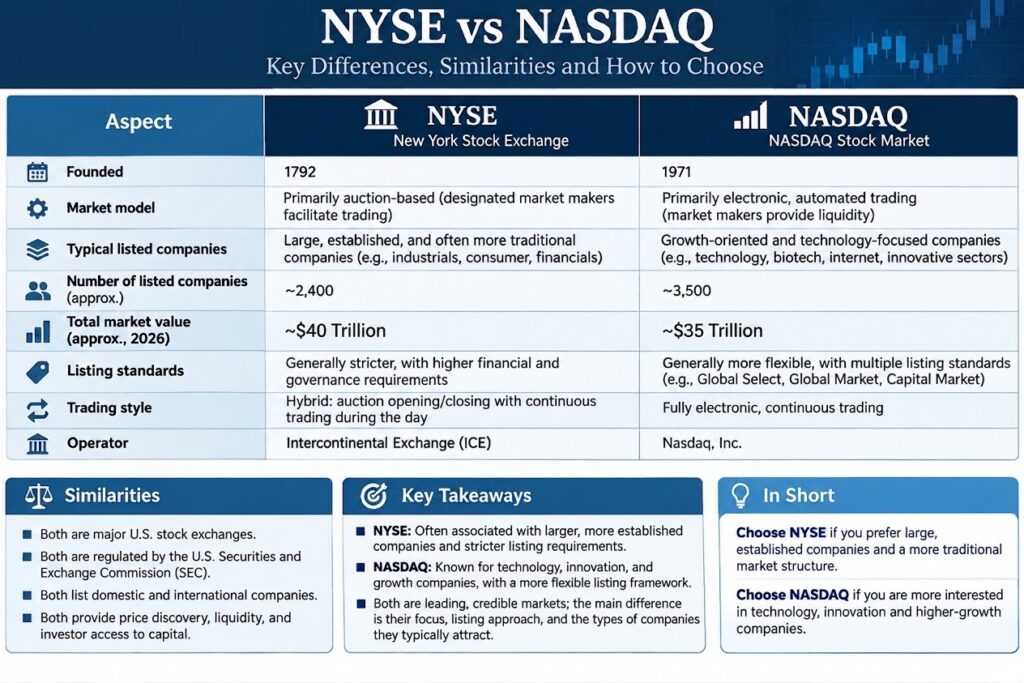
4. NYSE vs NASDAQ: Side-by-Side Comparison
| Feature | NYSE | NASDAQ |
|---|---|---|
| Historical origin | 1792 | 1971 |
| Market model | Hybrid electronic and floor-based | Electronic exchange |
| Trading floor | Yes | No traditional centralized trading floor |
| Liquidity providers | Designated market makers and other participants | Competing market makers and other participants |
| Regular trading hours | 9:30 a.m.–4:00 p.m. ET | 9:30 a.m.–4:00 p.m. ET |
| Typical historical association | Established corporations and traditional industries | Technology and growth companies |
| Technology companies | Yes | Yes |
| Established industrial companies | Yes | Yes |
| Opening and closing auctions | Yes | Yes |
| Federal securities regulation | SEC oversight | SEC oversight |
| Investor access | Through brokerage services | Through brokerage services |
| Automatically safer? | No | No |
The comparison shows that the two exchanges have different histories and market structures, but they perform many of the same essential economic functions.
5. How Does Stock Trading Actually Work?
For beginners, the easiest way to understand stock trading is to follow a hypothetical transaction.
Step 1: A Company Has Publicly Traded Shares
Suppose Example Corporation has 100 million shares outstanding and is listed on the NYSE.
Investors can submit orders to buy or sell those shares through brokers.
Step 2: An Investor Opens a Brokerage Account
A brokerage account provides access to securities markets.
The investor typically completes identification, regulatory, and account-opening procedures before depositing funds.
Step 3: The Investor Searches for the Stock
Most broker platforms allow searches by company name or ticker symbol.
A ticker symbol is a short identifier assigned to a listed security.
Step 4: The Investor Places an Order
Suppose the investor wants to buy 10 shares at approximately $50 each.
The investor may enter a market order or limit order.
Step 5: The Broker Routes the Order
The broker determines where to send the order under its routing arrangements and applicable execution obligations.
Importantly, an order for a NYSE-listed stock does not necessarily execute on the NYSE itself.
U.S. equities trade across multiple exchanges and other execution venues.
Step 6: The Order Is Executed
If compatible buying and selling interest is available, the order may execute.
The broker confirms the quantity, price, and transaction details.
Step 7: Clearing and Settlement Occur
Execution is not the same as final settlement.
Clearing and settlement processes ensure that securities and funds are delivered between the relevant parties.
For most U.S. stock transactions, the standard settlement cycle is T+1, meaning one business day after the trade date, subject to applicable exceptions.
Step 8: The Investor Owns the Shares
Shares are typically held through brokerage custody arrangements, often in street name.
The investor’s account reflects the position and its changing market value.
6. Primary Markets vs Secondary Markets
To understand the role of exchanges, it is important to distinguish between primary and secondary markets.
Primary Market
The primary market is where securities are issued to raise capital.
For example, a company may sell newly issued shares in an initial public offering.
The company receives proceeds from those newly issued shares, after relevant offering expenses.
Secondary Market
The secondary market is where existing securities are traded among investors.
If you buy 100 existing shares from another investor through a broker, the company generally does not receive your purchase payment.
The selling investor receives the proceeds, subject to transaction costs and settlement arrangements.
Why Secondary Markets Matter to Companies
Even when the company receives no money from an ordinary secondary-market trade, an active market can benefit it by:
- providing liquidity to shareholders;
- supporting investor confidence;
- establishing observable market valuations;
- making future capital raising more practical; and
- facilitating share-based compensation and acquisitions.
7. How Are Stock Prices Determined?
Stock prices are determined through interactions between buyers and sellers.
Investors submit orders reflecting the prices they are willing to pay or accept.
The Bid Price
The bid is the price at which a buyer is willing to purchase shares.
The Ask Price
The ask, also called the offer, is the price at which a seller is willing to sell shares.
Example
Suppose a stock has the following quotations:
- Best bid: $99.95
- Best ask: $100.05
The quoted spread is:
$100.05 − $99.95 = $0.10
This is called the bid-ask spread.
A narrower spread generally means a lower immediate cost of buying at the ask and selling at the bid, assuming sufficient available quantity and no other costs.
What Makes Prices Rise?
Prices may rise when buying demand increases relative to available selling interest.
Reasons can include:
- strong earnings;
- improved growth expectations;
- new products;
- falling interest rates;
- positive industry developments;
- institutional buying; and
- changes in investor sentiment.
What Makes Prices Fall?
Prices may fall because of:
- disappointing financial results;
- weak forecasts;
- economic recession;
- higher financing costs;
- regulatory concerns;
- competition;
- unexpected losses; and
- selling pressure.
The listing exchange is not the fundamental source of a company’s economic value. Business performance, expected cash flows, risk, and investor expectations are much more important.
8. NYSE’s Designated Market Maker System
One of the NYSE’s distinctive features is its designated market maker system.
What Is a Designated Market Maker?
A DMM is a specialized exchange participant assigned to particular NYSE-listed securities.
Its responsibilities include market-making and participation in opening and closing auction processes.
What Does a DMM Do?
A DMM may:
- provide liquidity by quoting prices;
- use its own capital in trading;
- facilitate opening auctions;
- facilitate closing auctions;
- assist with orderly price discovery; and
- perform responsibilities established by exchange rules.
Does a DMM Control the Stock Price?
No.
A DMM does not possess unlimited authority to determine what a company’s shares are worth.
Market prices reflect trading interest across a much broader marketplace.
Can a DMM Prevent a Stock Market Crash?
No.
Market-making mechanisms may support orderly trading, but they cannot eliminate losses or prevent securities from declining sharply when economic conditions deteriorate.
Why Retain Human Participation?
The NYSE emphasizes the role of human judgment in handling certain auctions and complex market conditions alongside automated systems.
That does not make the NYSE an old-fashioned manual exchange. Its operations are overwhelmingly technology-driven.
9. NASDAQ’s Electronic Market Maker System
NASDAQ uses an electronic trading model in which registered market makers and other market participants provide buying and selling interest.
What Is a Market Maker?
A market maker is a financial firm that stands ready, under applicable obligations, to buy and sell specified securities using its own account.
It may display both bid and ask quotations.
How Does a Market Maker Earn Money?
A market maker may earn trading profits from differences between buying and selling prices and from other aspects of its trading activity.
However, market making also involves:
- inventory risk;
- price movements;
- execution costs;
- technology costs;
- competition; and
- regulatory obligations.
Market makers can lose money.
Multiple Market Makers
NASDAQ-listed securities can have multiple competing market makers.
Competition may contribute to liquidity and competitive quotations.
Does NASDAQ Have Opening and Closing Auctions?
Yes.
A common misconception is that only the NYSE conducts auctions.
NASDAQ operates electronic Opening Cross and Closing Cross mechanisms designed to establish opening and closing prices through the aggregation of eligible orders.
NYSE vs NASDAQ Market Structure
The simplified distinction is:
- NYSE: electronic trading with a distinctive DMM and floor-broker framework.
- NASDAQ: electronic trading with competing market makers and electronic auction systems.
Both exchanges involve complex electronic order books, liquidity providers, and automated execution.
10. What Is an Order Book?
An order book contains buying and selling interest submitted to a trading venue.
It helps explain how securities are matched.
Example of a Simplified Order Book
| Buy Quantity | Bid | Ask | Sell Quantity |
|---|---|---|---|
| 200 | $49.98 | $50.02 | 150 |
| 400 | $49.95 | $50.05 | 300 |
| 500 | $49.90 | $50.10 | 600 |
In this hypothetical example, the highest displayed bid is $49.98 and the lowest displayed ask is $50.02.
An investor willing to buy immediately may interact with the available selling interest, subject to order routing and execution rules.
The displayed order book does not necessarily show every available order. Hidden liquidity and orders on other venues may also exist.
11. Market Orders vs Limit Orders
Understanding order types is more important for beginners than choosing between the NYSE and NASDAQ.
Market Order
A market order generally seeks immediate execution at the best available price.
It prioritizes execution over price certainty.
If a stock is quoted at $100, a market order does not guarantee execution at exactly $100.
Limit Order
A limit order specifies the maximum price a buyer will pay or the minimum price a seller will accept.
For example, a buy limit order at $100 will not execute above $100, although it may execute at a lower price.
Execution is not guaranteed.
Stop Orders
A stop order becomes active when a specified trigger condition is met.
Depending on the order type, it may become a market order or limit order.
A stop price is not necessarily a guaranteed execution price.
Why Beginners Should Understand Limit Orders
Limit orders can be useful when:
- trading less liquid stocks;
- trading during volatile periods;
- participating in extended-hours sessions;
- avoiding purchases above a predetermined price; and
- maintaining discipline.
However, a limit order may remain unfilled if the market does not reach the specified price.
12. Trading Hours: When Are NYSE and NASDAQ Open?
The standard U.S. stock market session for both exchanges is:
9:30 a.m. to 4:00 p.m.
U.S. Eastern Time, Monday through Friday, excluding applicable market holidays and special closures.
These are regular trading hours, not necessarily the only hours during which shares may trade.
Pre-Market Trading
Pre-market trading takes place before the regular session.
NASDAQ’s established pre-market session runs from 4:00 a.m. to 9:30 a.m. Eastern Time. Broker access may be narrower.
NYSE-listed shares may also trade before the regular opening through eligible venues and sessions, although the NYSE’s own sessions differ by market and security category.
After-Hours Trading
Trading can continue after 4:00 p.m. on supported venues and brokerage platforms.
NASDAQ’s established post-market session runs until 8:00 p.m. Eastern Time.
Why Extended-Hours Trading Is Riskier
Extended-hours trading may involve:
- fewer participants;
- lower liquidity;
- wider bid-ask spreads;
- greater price volatility;
- partial order execution;
- different order-type restrictions; and
- prices that differ substantially from the following regular session.
Will the U.S. Stock Market Become a 24-Hour Market?
U.S. exchanges and other trading venues have been developing expanded trading-hour arrangements.
NASDAQ has described a proposed nearly continuous weekday trading framework, subject to regulatory and market-infrastructure readiness.
Investors should not assume that every exchange, stock, or brokerage account supports overnight trading. Current trading schedules should always be checked with the relevant exchange and broker.
13. Why Do Companies List on the NYSE or NASDAQ?
Companies choose a listing venue for several reasons.
Access to Investors
A major U.S. exchange listing can make a company’s shares accessible to a broad range of institutional and individual investors.
Liquidity
Public listing creates opportunities for existing shareholders to trade their shares.
Reputation and Visibility
Exchange listings may enhance a company’s public profile and provide exposure to investors, analysts, and financial media.
Future Fundraising
A publicly traded company may conduct additional share offerings, subject to securities laws and market conditions.
Employee Compensation
Publicly traded shares can support stock-based compensation plans.
Acquisitions
Companies may use their shares as consideration when acquiring other businesses.
Listing Costs and Requirements
Exchanges impose initial and continuing listing requirements, fees, and governance standards.
Companies evaluate these alongside market structure, shareholder composition, investor relations, and strategic considerations.
14. NYSE vs NASDAQ Listing Requirements
Both exchanges require companies to satisfy eligibility and continuing-listing standards.
Requirements may involve:
- publicly held shares;
- shareholder distribution;
- market value;
- share price;
- financial performance;
- corporate governance;
- independent directors;
- audit committees;
- financial reporting; and
- shareholder approval rules.
Does NASDAQ Have Easier Requirements?
NASDAQ operates multiple listing tiers, allowing different types of eligible companies to qualify under different standards.
These include:
- NASDAQ Global Select Market;
- NASDAQ Global Market; and
- NASDAQ Capital Market.
The NYSE group also operates multiple exchange markets with different listing criteria.
It is therefore misleading to compare a single NYSE requirement with one NASDAQ tier and conclude that one entire exchange is always easier.
Can Unprofitable Companies Be Listed?
Yes, depending on the applicable financial and market-value standards.
Some listing pathways permit companies to qualify without a history of positive net income.
This is particularly relevant for growing businesses that have significant revenue, assets, market capitalization, or shareholder equity but are not yet profitable.
Does Listing Guarantee Financial Quality?
No.
Listing standards provide eligibility requirements, not guarantees of future profitability, solvency, or share-price performance.
A listed company can lose money, encounter fraud, default on obligations, or enter bankruptcy.
15. What Is an IPO?
An Initial Public Offering (IPO) is a process through which a company offers shares to public investors for the first time under an applicable securities-registration and offering framework.
Why Companies Conduct IPOs
Companies may go public to:
- raise capital;
- fund expansion;
- repay debt;
- support acquisitions;
- provide liquidity to existing shareholders; and
- establish a public market for their shares.
IPO Example
Suppose a company issues 20 million new shares at $25 each.
Gross proceeds are:
20,000,000 × $25 = $500,000,000
The company may receive the proceeds from newly issued shares after underwriting discounts and other offering expenses.
If existing shareholders also sell shares in the offering, those selling shareholders generally receive the proceeds from their own shares.
IPO Price vs First Trading Price
The IPO offering price and the price at which shares first trade on the exchange may differ.
For example:
- IPO offering price: $25;
- first exchange trade: $31;
- closing price: $28.
An investor buying at $31 has a different investment outcome from an investor allocated shares at $25.
Are IPOs Automatically Good Investments?
No.
Newly listed shares can be highly volatile, and some companies perform poorly after going public.
Investors should evaluate valuation, profitability, cash flow, growth expectations, dilution, governance, and business risks rather than assuming an IPO will rise in price.
16. IPOs, Direct Listings, and SPACs
Not every company enters the public market through a traditional IPO.
Traditional IPO
A traditional IPO generally involves underwriters, an offering price, and a structured distribution of shares.
Direct Listing
A direct listing can provide a route to public trading without the same traditional underwriting and allocation structure.
Depending on the applicable framework, it may involve existing shareholders selling shares and, where permitted, a primary capital-raising component.
SPAC Transaction
A special purpose acquisition company, or SPAC, is generally formed to raise capital and pursue a business combination.
A private company may become publicly traded through a merger with a SPAC.
Does the Exchange Determine Which Method Is Best?
No.
The appropriate route depends on financing needs, ownership objectives, market conditions, legal requirements, investor demand, and transaction costs.
17. Can a Company Switch from NYSE to NASDAQ?
Yes.
A company may transfer its primary listing from one exchange to another, subject to applicable requirements.
Reasons may include:
- listing economics;
- market-structure preferences;
- investor relations;
- corporate strategy;
- exchange services; and
- brand positioning.
What Happens to Existing Shareholders?
A transfer between exchanges generally does not require shareholders to sell their shares.
The underlying ownership interest in the company remains the same, although ticker or administrative details may change.
Does the Stock Price Automatically Increase?
No.
A listing transfer does not automatically improve earnings, cash flows, dividends, or business value.
Market reactions may occur, but future returns depend on broader factors.
18. NYSE vs NASDAQ: Which Exchange Is Bigger?
The answer depends on how size is measured.
Total Market Capitalization
One common measure is the combined market capitalization of companies listed on an exchange.
The NYSE has historically been among the largest exchanges globally by domestic listed-company market capitalization.
NASDAQ also ranks among the world’s largest and contains several of the most valuable companies in the global economy.
Number of Listed Companies
Another measure is the number of listed issuers or securities.
Counts can vary depending on whether they include:
- domestic companies;
- foreign companies;
- exchange-traded funds;
- preferred shares;
- special purpose acquisition companies; and
- other listed products.
Trading Volume
Trading volume measures the number of shares traded over a specified period.
Exchange-level volume is different from consolidated trading volume in shares listed on that exchange.
A NYSE-listed stock can trade on NASDAQ or another venue, and vice versa.
Why Fixed Rankings Can Become Outdated
Market capitalization, company counts, and trading volume change over time.
For accurate current comparisons, use official exchange statistics and specify the measurement date and methodology.
19. What Is Market Capitalization?
Market capitalization, often shortened to market cap, measures the market value of a company’s outstanding equity shares.
For a simple single-class example:
Market Capitalization = Share Price × Shares Outstanding
Example
Suppose a company has:
- share price: $80;
- shares outstanding: 500 million.
Market capitalization is:
$80 × 500,000,000 = $40 billion
Does Market Cap Equal the Company’s Cash?
No.
Market capitalization represents the market value of equity, not the cash held by the business.
Does Market Cap Equal Enterprise Value?
No.
Enterprise value considers additional claims and adjustments, commonly including debt, cash, and certain other financing interests.
Market capitalization is useful for comparing company size, but it is not sufficient for determining whether shares are undervalued or overvalued.
20. NYSE vs NASDAQ: Which Has More Technology Stocks?
NASDAQ has a strong historical association with technology and growth companies.
However, the distinction is not absolute.
Why Technology Companies Have Favored NASDAQ
Possible reasons include:
- historical relationships with technology issuers;
- investor familiarity;
- exchange branding;
- listing options;
- market-structure preferences; and
- the visibility of major technology companies already listed there.
Does NYSE List Technology Companies?
Yes.
NYSE-listed businesses include technology, software, digital services, communications, and financial-technology companies.
Does NASDAQ List Traditional Businesses?
Yes.
NASDAQ includes established companies in retail, consumer products, industrial services, financial services, and other sectors.
The exchange should never be used as a substitute for examining a company’s actual industry, revenue sources, business model, and financial statements.
21. Stock Exchanges vs Stock Market Indexes
This is one of the most important distinctions for beginners.
A stock exchange is a trading venue. A stock market index is a statistical measure tracking a selected group of securities.
The NYSE and NASDAQ are exchanges.
The S&P 500, Dow Jones Industrial Average, NASDAQ Composite, and NASDAQ-100 are indexes.
Example
Think of an exchange as a marketplace and an index as a scoreboard tracking a selected collection of companies.
The scoreboard does not itself operate the marketplace.
Can an Index Include Stocks from Both Exchanges?
Yes.
The S&P 500 contains eligible companies listed on major U.S. exchanges, including NYSE and NASDAQ.
Its membership is based on index-provider methodology, not on one exchange alone.
22. What Is the NASDAQ Composite Index?
The NASDAQ Composite is a market-capitalization-weighted index covering a broad universe of eligible securities listed on NASDAQ.
It is widely followed as an indicator of NASDAQ-listed equity performance.
Is It Only a Technology Index?
No.
Although technology-related businesses often have substantial influence, the index includes eligible companies from multiple sectors.
Why Does Technology Influence It So Much?
Large technology companies can have substantial market capitalizations and therefore significant index weights.
When major constituents rise or fall sharply, the index can move considerably.
23. What Is the NASDAQ-100?
The NASDAQ-100 is an index of 100 of the largest eligible non-financial companies listed on NASDAQ, subject to the index methodology.
It is not identical to the NASDAQ Composite.
NASDAQ Composite vs NASDAQ-100
| Feature | NASDAQ Composite | NASDAQ-100 |
|---|---|---|
| Coverage | Broad eligible NASDAQ-listed universe | 100 large eligible non-financial companies |
| Financial companies | May be included | Generally excluded under methodology |
| Concentration | Broader coverage | More concentrated |
| Weighting | Market-capitalization based | Modified market-capitalization methodology |
Index composition and eligibility are governed by published methodologies and may change.
24. What Is the Dow Jones Industrial Average?
The Dow Jones Industrial Average, commonly called the Dow, tracks 30 major U.S. companies selected under its methodology.
It is a price-weighted index.
That means share prices, adjusted through the index divisor, influence constituent weights rather than company market capitalizations alone.
Is the Dow the Same as the NYSE?
No.
The Dow is an index, while the NYSE is an exchange.
Dow constituents can be listed on either NYSE or NASDAQ.
Does a High Dow Level Mean Every Stock Is Rising?
No.
An index can rise even while many individual stocks decline.
Large movements in influential constituents can outweigh declines elsewhere.
25. What Is the S&P 500?
The S&P 500 is one of the most widely followed benchmarks for large U.S. companies.
It contains 500 leading companies selected under defined eligibility and committee-based methodology.
Its weighting is based on float-adjusted market capitalization.
Why Is the S&P 500 Important?
It is widely used for:
- investment benchmarking;
- index funds;
- exchange-traded funds;
- portfolio performance analysis;
- institutional asset management; and
- financial-market research.
NYSE vs NASDAQ vs S&P 500
These are not three competing exchanges.
- NYSE: exchange.
- NASDAQ: exchange.
- S&P 500: index.
A company listed on either exchange may qualify for the S&P 500 if it meets the applicable criteria and is selected.
26. Can You Invest Directly in the NYSE or NASDAQ Index?
An index is a calculation, not a security that investors can ordinarily buy directly.
Investors may obtain index exposure through financial products such as exchange-traded funds or mutual funds designed to track an index.
Examples of Index-Tracking Funds
Common examples include:
- SPY — an ETF tracking the S&P 500;
- VOO — an ETF tracking the S&P 500;
- IVV — an ETF tracking the S&P 500;
- QQQ — an ETF tracking the NASDAQ-100; and
- QQQM — another ETF tracking the NASDAQ-100.
These products differ in fees, structure, trading characteristics, and other details.
Is QQQ the Same as Buying NASDAQ?
No.
QQQ provides exposure to the NASDAQ-100 index through an ETF. It does not represent ownership of every NASDAQ-listed company or the Nasdaq exchange operator.
Can an ETF Trade on a Different Exchange from Its Holdings?
Yes.
The exchange on which an ETF trades does not determine where every underlying security is listed.
27. NYSE vs NASDAQ: Which Is Better for Beginners?
Neither exchange is inherently better for a beginner.
The quality of an investment depends primarily on what is being purchased, the price paid, the investor’s objectives, and the risks involved.
Questions Beginners Should Ask
- What does the company sell?
- How does it earn money?
- Is it profitable?
- Does it generate operating cash flow?
- How much debt does it have?
- Is the stock expensive relative to its financial performance?
- Does it pay dividends?
- What risks could damage the business?
- How diversified is the investor’s portfolio?
- How long can the investor hold the investment?
A profitable, financially strong company listed on NASDAQ may be less risky than a financially distressed company listed on the NYSE.
The reverse can also be true.
The listing venue is not an adequate measure of investment quality.
28. Is NYSE Safer Than NASDAQ?
Both exchanges operate within the U.S. securities regulatory framework.
Both impose listing standards and market rules.
However, neither guarantees that an investment will be safe.
Types of Investment Risk
- Market risk: share prices may fall because of broad market movements.
- Business risk: a company may lose customers or become uncompetitive.
- Financial risk: excessive debt may threaten solvency.
- Valuation risk: investors may pay too much for expected future earnings.
- Liquidity risk: shares may be difficult to sell at an acceptable price.
- Governance risk: weak oversight or misconduct may harm shareholders.
- Currency risk: international investors may experience exchange-rate losses.
- Regulatory risk: changes in laws may affect business operations.
Can a NYSE Company Go Bankrupt?
Yes.
Can a NASDAQ Company Go Bankrupt?
Yes.
Major exchange listings do not eliminate the possibility of permanent capital loss.
29. Does NASDAQ Have More Volatile Stocks?
NASDAQ is often associated with growth-oriented businesses whose valuations depend heavily on expected future earnings.
Such companies can be sensitive to changes in interest rates, economic expectations, and investor sentiment.
However, it is incorrect to assume that every NASDAQ stock is more volatile than every NYSE stock.
What Determines Volatility?
Important factors include:
- business maturity;
- earnings stability;
- leverage;
- industry cyclicality;
- investor expectations;
- shareholder concentration;
- trading liquidity;
- company news; and
- broader market conditions.
Volatility vs Risk
Volatility measures price fluctuations. Risk is broader and includes the possibility of permanent financial loss.
A stock with low short-term volatility may still carry serious financial or business risks.
30. NYSE vs NASDAQ: Which Offers Better Dividends?
Dividends are distributions made by companies to eligible shareholders when declared.
The exchange itself does not require every company to pay dividends.
Why Some Companies Pay Dividends
Mature businesses may distribute part of their profits or available capital to shareholders.
Why Some Companies Do Not
Growing companies may prefer to reinvest resources in:
- research and development;
- new facilities;
- technology;
- acquisitions;
- marketing; and
- business expansion.
Dividend Yield
Dividend yield is commonly calculated as:
Annual Dividend Per Share ÷ Share Price × 100
If annual dividends are $3 per share and the stock trades at $75:
$3 ÷ $75 × 100 = 4%
Does a Higher Yield Mean a Better Investment?
Not necessarily.
A high dividend yield may result from a falling share price and can signal financial stress.
Investors should examine dividend coverage, cash flow, debt, capital requirements, and payout sustainability.
31. How Do Stock Exchanges Make Money?
Stock exchanges are businesses with operating expenses, employees, technology systems, regulatory obligations, and commercial revenue streams.
Listing Fees
Companies may pay initial and annual listing fees.
Trading Fees
Exchange operators may charge transaction-related fees and offer rebates under their published fee schedules.
Market Data
Market participants and data distributors may pay for access to proprietary market information.
Technology Services
Exchange groups may provide technology infrastructure, connectivity, and related services.
Other Financial Services
Exchange groups may operate businesses involving analytics, financial indexes, derivatives markets, clearing-related infrastructure, and other services.
Can Investors Buy Shares in Exchange Operators?
Yes, where publicly traded.
Nasdaq, Inc. trades under NDAQ, while Intercontinental Exchange trades under ICE.
Buying those shares is an investment in the exchange operator’s business, not an investment in all companies listed on its exchange.
32. Who Regulates NYSE and NASDAQ?
The primary federal securities regulator in the United States is the Securities and Exchange Commission (SEC).
Role of the SEC
The SEC oversees securities markets and administers federal securities laws.
Its responsibilities include areas such as:
- market regulation;
- corporate disclosure;
- investor protection;
- enforcement;
- broker-dealer regulation; and
- oversight of registered securities exchanges.
Self-Regulatory Organizations
Registered exchanges operate as self-regulatory organizations under applicable U.S. securities law.
They establish and enforce exchange rules subject to SEC oversight.
What Is FINRA?
The Financial Industry Regulatory Authority, or FINRA, is a self-regulatory organization overseeing member broker-dealers and performing other regulatory functions.
FINRA is not the same as the SEC and does not replace the SEC’s federal regulatory authority.
What Is SEC EDGAR?
EDGAR is the SEC’s electronic filing system.
Investors can use it to examine filings such as:
- Form 10-K annual reports;
- Form 10-Q quarterly reports;
- Form 8-K current reports;
- proxy statements;
- registration statements; and
- certain beneficial ownership reports.
These disclosures are often much more useful for evaluating a stock than simply knowing which exchange lists it.
33. What Is SIPC Protection?
The Securities Investor Protection Corporation, or SIPC, provides limited protection for eligible customers of member broker-dealers when a brokerage firm fails and customer securities or cash are missing.
For eligible claims, standard protection is generally up to $500,000 per customer, including a $250,000 limit for cash.
Coverage is subject to legal requirements and exclusions.
Does SIPC Protect Against Stock Market Losses?
No.
If you buy a stock for $100 and its market price falls to $40, SIPC does not reimburse the $60 decline.
SIPC is not an investment-performance guarantee.
Is SIPC the Same as FDIC Insurance?
No.
FDIC insurance concerns eligible deposits at insured banks, subject to applicable limits and conditions.
SIPC protection concerns eligible brokerage customer assets under a different framework.
34. What Happens When Trading Is Halted?
A trading halt temporarily suspends trading in a security or across part of the market under applicable rules.
Why Individual Stocks May Be Halted
Possible reasons include:
- pending material news;
- regulatory concerns;
- extreme price movements;
- order imbalances;
- technical problems; and
- other exchange-rule conditions.
Limit Up-Limit Down Mechanism
The U.S. equity market uses a Limit Up-Limit Down framework intended to address extraordinary price movements in covered securities.
It establishes price bands and may lead to trading pauses under specified conditions.
Market-Wide Circuit Breakers
U.S. equity markets also use market-wide circuit breakers tied to declines in the S&P 500.
The principal decline thresholds are:
- Level 1: 7%;
- Level 2: 13%; and
- Level 3: 20%.
The resulting trading pauses or closures depend on the threshold and time of day.
Do Circuit Breakers Prevent Losses?
No.
They are designed to provide structured responses to extreme market conditions, not to guarantee price recovery.
35. What Happens If a Company Is Delisted?
Delisting means a security is removed from an exchange’s listing.
Possible Reasons
- failure to satisfy listing standards;
- insufficient share price;
- financial reporting failures;
- bankruptcy;
- merger or acquisition;
- going private; or
- voluntary listing withdrawal.
Do Shares Automatically Become Worthless?
No.
Delisting does not automatically eliminate legal ownership.
However, it may reduce liquidity, limit brokerage access, and increase risk.
In bankruptcy, common shareholders may recover little or nothing after higher-priority claims.
Can Delisted Stocks Trade Over the Counter?
Some may continue trading in over-the-counter markets if quotation and trading arrangements are available.
Not every delisted stock will have an active or accessible secondary market.
36. NYSE vs NASDAQ vs OTC Markets
Over-the-counter, or OTC, trading generally refers to securities trading outside the traditional listing and execution framework of major national stock exchanges.
OTC securities may have very different reporting, quotation, and liquidity characteristics.
Are All OTC Companies Fraudulent?
No.
Some legitimate foreign or domestic companies have OTC-traded securities.
However, certain OTC segments carry substantial disclosure, liquidity, manipulation, and investor-protection risks.
Why Major Exchange Listings Matter
NYSE and NASDAQ listings generally involve defined eligibility and ongoing obligations that may provide additional transparency and market infrastructure.
Those safeguards are meaningful, but they do not guarantee investment success.
37. How Do International Investors Buy NYSE or NASDAQ Stocks?
Investors outside the United States may access U.S.-listed shares through brokerage firms offering international market access.
Typical Steps
- Choose a regulated brokerage firm.
- Confirm access to U.S. securities.
- Complete account verification.
- Review fees, currency conversion, and custody arrangements.
- Deposit funds.
- Search for the desired security.
- Review company information and investment risks.
- Submit an appropriate order.
- Monitor the position and relevant disclosures.
Currency Conversion
Most U.S.-listed common shares trade in U.S. dollars.
An international investor whose home currency differs from the dollar faces exchange-rate risk.
Example
Suppose an investor buys shares worth $10,000.
The shares rise 10%, making the investment worth $11,000.
However, if the U.S. dollar depreciates substantially against the investor’s home currency, the return measured in that home currency may be lower than 10% or even negative.
Tax Considerations
International investors may encounter:
- U.S. dividend withholding tax;
- tax treaty provisions;
- domestic taxation in their country of residence;
- foreign tax credit rules;
- estate tax considerations; and
- brokerage tax documentation requirements.
Tax treatment depends on the investor’s circumstances, residency, securities held, and applicable law.
38. How Much Money Do You Need to Invest?
There is no universal minimum investment amount for all NYSE and NASDAQ stocks.
The required amount depends on:
- share price;
- brokerage minimums;
- fractional-share availability;
- trading fees;
- currency conversion costs; and
- the investor’s financial circumstances.
Whole Shares
If a stock costs $120 and the broker requires whole-share purchases, one share costs approximately $120 before fees.
Fractional Shares
Some brokers allow investors to buy fractions of shares.
For example, investing $30 in a stock trading at $120 could provide exposure equivalent to approximately 0.25 share, subject to broker terms and execution.
Does Investing a Small Amount Eliminate Risk?
No.
The percentage loss can be the same whether the investment is $50 or $50,000.
However, the absolute amount at risk differs.
39. What Are the Real Costs of Buying Stocks?
Even when a brokerage advertises commission-free trading, investing may involve other costs.
Brokerage Commissions
Some brokers charge commissions, while others offer zero-commission trading for eligible transactions.
Bid-Ask Spread
The spread creates a potential implicit trading cost.
Currency Conversion
International investors may pay a currency conversion spread or fee.
Regulatory and Transaction Fees
Certain transactions may involve regulatory or other charges.
ETF Expense Ratios
ETFs generally have ongoing fund operating expenses reflected through their expense ratios.
Margin Interest
Borrowing money from a broker to buy securities can create interest expense and additional risk.
Taxes
Dividends, capital gains, and other investment returns may be taxable depending on applicable rules.
Why Costs Matter
Frequent trading can produce substantial cumulative costs, even when individual fees appear small.
Investors should evaluate the total cost of investing rather than focusing only on advertised commissions.
40. How Do You Analyze a NYSE or NASDAQ Company?
A beginner should start with the business itself.
Understand the Business Model
Ask:
- What products or services does the company sell?
- Who are its customers?
- How does it earn revenue?
- What are its major costs?
- What advantages does it have over competitors?
Read the Income Statement
The income statement shows revenue, expenses, and profit over a period.
Important measures include:
- revenue;
- gross profit;
- operating income;
- net income; and
- earnings per share.
Read the Balance Sheet
The balance sheet shows assets, liabilities, and equity at a reporting date.
Important items include:
- cash;
- receivables;
- inventory;
- debt;
- lease liabilities;
- other obligations; and
- shareholders’ equity.
Read the Cash Flow Statement
Cash flow information helps assess whether accounting earnings are supported by actual cash generation.
Review:
- operating cash flow;
- capital expenditures;
- investing cash flows;
- financing cash flows;
- debt repayments;
- dividends; and
- share repurchases.
Evaluate Financial Ratios
Useful measures include:
- price-to-earnings ratio;
- price-to-sales ratio;
- return on equity;
- return on invested capital;
- operating margin;
- debt-to-equity ratio;
- interest coverage;
- free cash flow; and
- earnings growth.
Ratios should be interpreted in the context of the company’s industry, accounting policies, business cycle, and financial condition.
41. Understanding the Price-to-Earnings Ratio
The price-to-earnings ratio, or P/E ratio, compares share price with earnings per share.
P/E Ratio = Share Price ÷ Earnings Per Share
Example
A company has:
- share price: $90;
- annual earnings per share: $5.
The P/E ratio is:
$90 ÷ $5 = 18
Is a Low P/E Always Better?
No.
A low P/E may reflect undervaluation, slow growth, cyclical peak earnings, financial distress, or market concerns.
Is a High P/E Always Bad?
No.
A high P/E may reflect expectations of strong future growth, although those expectations may prove overly optimistic.
Valuation should consider earnings quality, growth, cash flow, risk, and realistic future assumptions.
42. What Is the Difference Between Investing and Trading?
Investing
Investing generally involves acquiring assets with an expectation of long-term economic returns.
Long-term investors may focus on:
- business fundamentals;
- competitive advantages;
- cash generation;
- valuation;
- dividends;
- diversification; and
- long-term compounding.
Trading
Trading generally involves buying and selling securities to profit from shorter-term price movements.
Traders may focus on:
- price trends;
- momentum;
- volume;
- volatility;
- market microstructure;
- technical analysis; and
- risk management.
Which Approach Is Better?
There is no universal answer.
However, short-term trading involves execution risk, behavioural challenges, transaction costs, and the possibility of substantial losses.
Beginners should understand these risks before engaging in frequent speculative trading.
43. Common Beginner Mistakes
Believing NYSE Stocks Are Automatically Safer
The exchange does not guarantee financial strength.
Believing NASDAQ Contains Only Technology Companies
NASDAQ includes multiple industries.
Confusing NASDAQ with the NASDAQ-100
One is an exchange; the other is an index.
Buying Because a Stock Has a Low Share Price
A $5 stock is not automatically cheaper in valuation terms than a $500 stock.
Share price must be considered alongside shares outstanding, earnings, cash flows, and other financial information.
Ignoring Market Capitalization
A company’s total equity market value is more informative about size than share price alone.
Chasing IPO Excitement
IPO prices can be volatile, and popular offerings may trade at valuations that assume unrealistic future growth.
Using Market Orders in Illiquid Stocks
Execution prices may differ substantially from expectations.
Ignoring Financial Statements
Brand recognition and share-price momentum are not substitutes for financial analysis.
Concentrating Everything in One Stock
A single company’s failure can cause a large permanent loss.
Confusing Diversification with Owning Many Similar Stocks
Owning ten companies exposed to the same industry or risk factor may provide less diversification than expected.
Assuming Past Returns Will Continue
Historical performance does not guarantee future investment results.
44. Practical Example: Comparing Two Companies
Consider two hypothetical businesses.
Company A is listed on the NYSE. Company B is listed on NASDAQ.
| Metric | Company A (NYSE) | Company B (NASDAQ) |
|---|---|---|
| Annual revenue | $10 billion | $6 billion |
| Net income | $1 billion | $900 million |
| Net profit margin | 10% | 15% |
| Market capitalization | $20 billion | $45 billion |
| Price-to-earnings ratio | 20 | 50 |
| Expected growth | Moderate | High |
Company A has more revenue and a lower P/E ratio.
Company B has a higher profit margin and a higher valuation multiple.
Which is the better investment?
The table does not provide enough information to decide.
Company B’s valuation may be justified by strong future growth, or it may be excessively optimistic. Company A may offer attractive value, or it may face structural decline.
The appropriate analysis requires cash flow, debt, competitive position, future earnings, risk, and valuation assumptions.
The exchange listing itself does not answer the investment question.
45. How to Research a Company Before Buying
A disciplined beginner can follow this research sequence.
- Identify the business. Confirm its legal name, ticker, and primary listing.
- Understand revenue. Determine how the company earns money.
- Review profitability. Examine operating income, net income, and margins.
- Examine cash flow. Compare earnings with operating cash generation.
- Evaluate debt. Consider leverage, interest costs, and maturity obligations.
- Review growth. Assess whether historical growth is sustainable.
- Study competition. Identify threats to the business model.
- Check governance. Examine leadership, ownership, and material related-party transactions.
- Assess valuation. Compare the market price with reasonable financial expectations.
- Consider diversification. Evaluate how the investment affects overall portfolio risk.
- Review transaction costs. Include fees, spreads, and currency conversion.
- Determine position size. Avoid risking funds needed for essential near-term expenses.
46. Frequently Asked Questions About NYSE vs NASDAQ
Is NYSE the same as Wall Street?
No. Wall Street is a geographical location and a broad expression referring to the American financial industry. The NYSE is a specific securities exchange.
Is NASDAQ a stock exchange or an index?
NASDAQ is a stock exchange, while the NASDAQ Composite and NASDAQ-100 are stock indexes.
Can I buy Apple shares on the NYSE?
Apple is primarily listed on NASDAQ. However, its shares may execute on other U.S. trading venues, including exchanges other than its primary listing venue.
Can I buy NYSE and NASDAQ shares using one broker?
Many brokers provide access to securities listed on both exchanges through a single account.
Does NASDAQ have a physical trading floor?
NASDAQ does not operate the traditional centralized trading-floor model associated with the NYSE.
Is NYSE completely manual?
No. The NYSE is highly automated and combines electronic trading with specialized floor-based functions.
Which exchange has more technology companies?
NASDAQ is particularly associated with technology businesses, although both exchanges list technology companies.
Which exchange has better stocks?
Neither exchange has universally better stocks. Investment quality must be evaluated company by company.
Does a NASDAQ listing mean a company is small?
No. Some of the world’s largest companies are listed on NASDAQ.
Does an NYSE listing mean a company is profitable?
No. Listing eligibility and continuing standards do not guarantee ongoing profitability.
Can a company list on both exchanges simultaneously?
Companies generally select a primary listing venue for their common shares, although securities may trade on multiple venues and particular dual-listing or cross-listing arrangements can exist.
Can a company move from NASDAQ to NYSE?
Yes, subject to the receiving exchange’s requirements and applicable procedures.
Are NYSE and NASDAQ open on weekends?
The regular U.S. equity trading sessions are generally closed on Saturdays and Sundays.
Are the exchanges open on public holidays?
They observe specified U.S. market holidays and may have scheduled early closures.
What time does the U.S. stock market open?
The regular session opens at 9:30 a.m. Eastern Time.
Can I trade stocks at night?
Some brokers and trading venues support extended-hours or overnight trading, subject to their rules, available securities, and market infrastructure.
What is the difference between a market order and a limit order?
A market order prioritizes execution, while a limit order imposes a specified price boundary but may not execute.
What happens if no one wants to buy my shares?
Your order may remain unfilled, or you may need to accept a lower price to attract buyers. Liquidity is not guaranteed.
What happens if a company goes bankrupt?
Shareholders have residual claims and may lose their entire investment.
Can the NYSE or NASDAQ guarantee profits?
No. Exchanges provide market infrastructure, not investment-return guarantees.
Can beginners lose more than they invest?
When buying fully paid shares without borrowing or derivatives, the loss is generally limited to the amount invested. Margin borrowing, short selling, and certain derivatives can create losses beyond the original capital committed.
Is investing in an ETF safer than buying individual stocks?
A diversified ETF can reduce company-specific concentration risk, but it still carries market risk and may decline substantially in value.
Does NASDAQ pay dividends?
NASDAQ-listed companies may pay dividends. The exchange itself does not distribute dividends on behalf of all listed companies. Nasdaq, Inc. as a separate publicly traded business may declare dividends to its own shareholders.
Is the S&P 500 part of the NYSE?
No. The S&P 500 is an index containing eligible companies listed on major U.S. exchanges.
Is the NASDAQ-100 the same as the S&P 500?
No. They have different eligibility rules, constituent universes, sector exposures, and weighting methodologies.
Can I invest with $100?
Potentially, depending on brokerage requirements, available securities, fractional-share arrangements, and transaction costs.
Should I choose a stock based on its exchange?
No. The company’s fundamentals, valuation, financial risks, and fit with your investment objectives should carry far greater weight.
47. NYSE vs NASDAQ: The Most Important Differences to Remember
After examining their histories, market structures, listed companies, trading mechanisms, and regulatory frameworks, the fundamental distinctions become easier to understand.
The NYSE originated as a physical securities marketplace and evolved into a modern electronic exchange that retains a distinctive trading floor and designated market maker system.
NASDAQ emerged from electronic quotation technology and developed into a fully electronic exchange associated with competing market makers and major technology-oriented issuers.
Both exchanges provide infrastructure for trading securities, support capital formation, operate opening and closing auctions, and function under U.S. securities regulation.
Both list major corporations, both can experience severe market volatility, and both contain companies with widely different levels of financial strength.
Neither exchange determines whether a stock is cheap or expensive. Neither guarantees dividends. Neither prevents bankruptcy. Neither ensures that investors will earn positive returns.
The most useful question is therefore not simply whether a company is listed on the NYSE or NASDAQ.
It is whether the company represents an attractive investment at its current valuation, considering its business prospects, financial condition, competitive position, and risks.
Beginner’s Quick Reference
- NYSE: A major U.S. stock exchange with electronic trading and a specialized trading-floor model.
- NASDAQ: A major electronic U.S. stock exchange strongly associated with technology and growth companies.
- Stock: An ownership interest in a company.
- Broker: A financial intermediary that provides access to securities transactions.
- Ticker: A symbol identifying a traded security.
- Bid: A price a buyer is willing to pay.
- Ask: A price a seller is willing to accept.
- Spread: The difference between bid and ask quotations.
- IPO: An initial public offering of shares.
- Market cap: The market value of outstanding equity shares.
- Index: A calculated benchmark tracking selected securities.
- ETF: A pooled investment fund whose shares trade on an exchange.
- Dividend: A distribution to shareholders when declared.
- Liquidity: The ability to trade without excessive price impact.
- Volatility: The degree of price fluctuation.
- SEC: The primary U.S. federal securities regulator.
48. Official Sources and Further Reading
For readers who want to verify exchange procedures, trading schedules, listing rules, and financial disclosures, the following official resources provide authoritative starting points.
- New York Stock Exchange: https://www.nyse.com/
- NYSE Trading Hours and Calendars: NYSE market hours
- NYSE Market Structure: NYSE trading model explanation
- NASDAQ: https://www.nasdaq.com/
- NASDAQ Trading Information: Nasdaq Trader
- NASDAQ Listing Rules: Nasdaq Listing Center
- U.S. Securities and Exchange Commission: https://www.sec.gov/
- SEC EDGAR Filings: SEC filing search
- Investor Education: Investor.gov
- FINRA: https://www.finra.org/
- SIPC: https://www.sipc.org/
Editorial note: Exchange rules, market sessions, listing thresholds, index constituents, and regulatory arrangements may change. This article explains the general structure and principles of U.S. equity markets. Readers should verify current operational details with the relevant official source before making time-sensitive decisions.
49. Understanding NYSE and NASDAQ Is the Beginning of Understanding the Stock Market
The NYSE and NASDAQ are not rival investment products that ordinary investors must choose between. They are major components of the infrastructure through which American securities markets operate.
The NYSE brings together a long-established exchange tradition, electronic trading, designated market makers, and a specialized auction framework. NASDAQ represents a different historical development rooted in electronic quotations, competing liquidity providers, and computerized market operations.
Both have helped businesses access public capital and investors trade ownership interests in companies.
For someone new to investing, understanding the exchanges is useful because it explains where securities are listed, how orders reach markets, why quotations change, what happens during trading halts, and how companies become publicly traded.
Yet the exchange is only the starting point.
Successful financial analysis requires understanding businesses, accounting statements, cash flows, valuation, economic conditions, diversification, and risk. A famous company is not automatically a good investment, and a good company is not automatically attractive at every share price.
The distinction between the NYSE and NASDAQ is therefore important for financial literacy, but the distinction between price and value, speculation and investing, and risk and expected return is ultimately more important for protecting capital and making informed decisions.
The Essential Lesson for Every New Investor
Do not buy a stock merely because it trades on the NYSE, appears on NASDAQ, belongs to a famous index, or is discussed enthusiastically in the financial media. Understand the company, examine its financial statements, assess its valuation, consider the risks, and invest according to a disciplined financial plan. The exchange provides the marketplace; the investor remains responsible for the investment decision.
Educational disclaimer: This article is provided for general accounting, financial-market, and investment education. It does not constitute individualized investment, legal, or tax advice. Securities involve risk, including possible loss of principal.