
The $600 Billion Question Behind Fort Knox: Has Anyone Actually Counted America’s Gold?
Behind America’s most famous vault lies a remarkable accounting story: decades of inventories, millions of ounces of gold, annual audits that rarely involve reopening the vaults, and a question that refuses to disappear. How do you prove that a nation’s treasure is still there?
Somewhere inside a heavily fortified building in Kentucky, the United States government says it keeps exactly 147,341,858.382 fine troy ounces of gold. Not approximately 147 million ounces. Not merely several thousand tonnes. The official accounting figure is recorded to three decimal places.
At the historical statutory accounting price of approximately $42.22 an ounce, that gold appears in Treasury records at just $6.22 billion. At a market price of $4,000 an ounce, it would be worth nearly $589.4 billion. At $5,000, the same inventory would be worth more than $736 billion.
Those enormous differences are not evidence of missing gold. They reveal something unusual about America’s public finances: one of the government’s most valuable physical assets is carried in its official accounts at a price established more than half a century ago.
But the valuation mystery is only the beginning.
In February 2025, President Donald Trump revived a question that has periodically haunted Washington: is all the gold really inside Fort Knox? Treasury Secretary Scott Bessent responded that the gold was present and accounted for, citing annual audits.
The public argument quickly divided into two camps. One believed that Fort Knox had never been properly audited. The other insisted that its gold was audited every year.
Both descriptions obscure the more interesting reality.
Fort Knox has undergone documented physical inventories. Gold bars have been counted, weighed and sampled. Government auditors have reported no discrepancies in major historical examinations. Yet the routine modern assurance system relies heavily on a different proposition: once a compartment has been inventoried, independently sealed and continuously controlled, auditors can obtain evidence of continuing custody without recounting every bar every year.
That is not inherently bad auditing. It is a recognizable approach to safeguarding assets that are supposed to remain untouched.
But it creates an extraordinary question about evidence, confidence and public accountability.
A vault can be almost impossible to rob and still be difficult for the public to verify. Security protects the gold from thieves. Auditing protects the public from uncertainty about what is actually there.
The central distinction
First, how much gold is really at Fort Knox?
According to the U.S. Treasury’s official October 31, 2026 inventory, Fort Knox holds 147,341,858.382 fine troy ounces of gold, equivalent to approximately 4,582.8 metric tonnes.
A fine troy ounce measures the pure gold content, not necessarily the gross weight of a bar containing other metals. This distinction matters because the government’s stored bars vary in purity. A bar weighing 400 gross troy ounces is not automatically 400 fine troy ounces.
Fort Knox contains approximately 56.3% of America’s reported official gold reserves. The remainder is distributed among other Treasury-controlled and Federal Reserve Bank custody locations.
| Reported location or category | Fine troy ounces | Approx. tonnes | Share |
|---|---|---|---|
| Fort Knox, Kentucky | 147,341,858.382 | 4,582.8 | 56.3% |
| West Point, New York | 54,067,331.379 | 1,681.7 | 20.7% |
| Denver, Colorado | 43,853,707.279 | 1,364.0 | 16.8% |
| Federal Reserve Bank custody | 13,452,810.545 | 418.4 | 5.1% |
| Mint working stock | 2,783,218.656 | 86.6 | 1.1% |
| Total | 261,498,926.341 | 8,133.5 | 100% |
Source: U.S. Treasury, Treasury-Owned Gold dataset, October 31, 2026. Federal Reserve Bank custody combines bullion and coin holdings, including small display quantities. Tonnes and shares are rounded.
There is another distinction frequently overlooked in public debate. The Federal Reserve Bank of New York holds gold belonging to foreign central banks and other official institutions. That foreign-owned gold is not part of America’s own gold reserves merely because it is physically stored on American soil.
Similarly, Fort Knox is not a Federal Reserve gold warehouse. Its bullion belongs to the U.S. Treasury, while the United States Mint acts as custodian.
Ownership and custody are different accounting concepts. The custodian is responsible for safeguarding the asset; the owner retains the economic interest.
The astonishing fact: America once kept far more gold inside Fort Knox
The modern Fort Knox inventory is enormous, but it is a fraction of what the facility once contained.
When the first shipments arrived in January 1937, the United States was accumulating gold during an extraordinary period of monetary upheaval. The Great Depression had shattered confidence in banks and currencies. Gold flowed toward the United States as governments and investors sought monetary security.
By December 31, 1941, according to the U.S. Mint, Fort Knox held a record 649.6 million fine troy ounces.
That was approximately 20,205 metric tonnes of pure gold content—more than four times its current reported inventory.
1941: The historic peak
649.6 million ounces. Gold accumulated during an era when international monetary arrangements depended heavily on official bullion reserves.
2026: The modern reserve
147.34 million ounces. About 22.7% of the historic Fort Knox peak, following decades of changes in American and international monetary arrangements.
What happened to the rest?
The decline reflects historical monetary transactions and changes in the international gold system, rather than evidence that hundreds of millions of ounces mysteriously disappeared from a sealed vault.
Under the Bretton Woods system established in 1944, foreign monetary authorities could exchange dollar holdings for gold at the official monetary price under applicable arrangements. As confidence in dollar convertibility weakened during the 1960s and early 1970s, America’s gold reserves came under pressure.
In August 1971, President Richard Nixon suspended the dollar’s convertibility into gold for foreign official holders. The subsequent collapse of Bretton Woods fundamentally changed gold’s monetary role.
Fort Knox’s holdings had already fallen substantially by then. The U.S. Mint’s historical record shows approximately 147.4 million fine troy ounces at Fort Knox in 1974—remarkably close to the amount reported today.
The important question is therefore not whether Fort Knox still contains its 1941 peak. It plainly is not supposed to.
The question is whether the approximately 147 million fine troy ounces recorded since the 1970s remain properly safeguarded and supported by reliable audit evidence.
How many times has Fort Knox actually been physically audited?
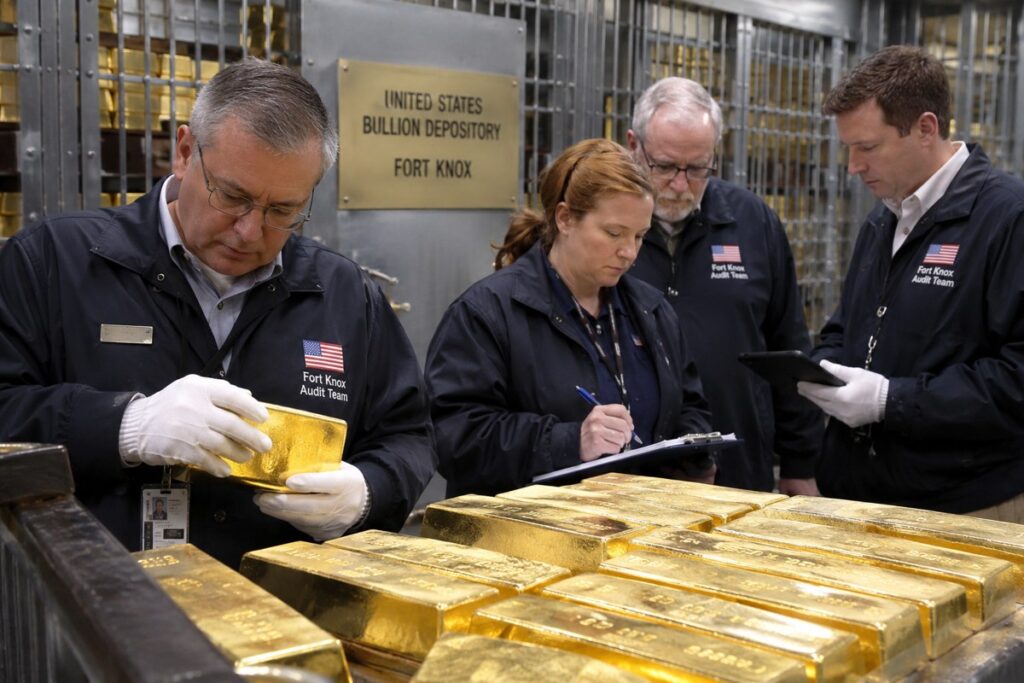
This is where the story becomes more complicated than either political slogan suggests.
There is no single publicly established number representing every physical audit, partial count, sample assay, compartment inspection and annual control examination conducted at Fort Knox since 1937.
More importantly, these activities are not interchangeable.
To understand the audit history, it is necessary to distinguish full inventories of individual compartments, partial inventories of the depository, recurring physical examination programmes, and annual verification of sealed compartments.
At least three major phases of documented physical verification can be identified: the 1953 special settlement, the 1974 GAO-observed inventory, and the continuing compartment-inventory programmes from 1975 through 2008.
These programmes involved multiple examinations rather than three isolated audit visits. Since 2008, routine audit procedures have relied principally on the inspection of official joint seals and related controls, according to GAO’s 2011 description.
The precise lifetime number of occasions on which Fort Knox compartments were opened and physically counted cannot responsibly be stated from these published summaries alone.
1953: Nearly 88,000 gold bars are counted
The first especially revealing document comes from the Treasury Secretary’s annual report for fiscal year 1953.
That report describes a special settlement involving Fort Knox’s gold inventory. The facility then contained 22 sealed compartments holding approximately 356.7 million fine troy ounces.
Officials selected three compartments for physical examination.
Their contents were counted and compared with the records. The Treasury reported approximately 88,000 bars containing 34,399,629.685 fine troy ounces, with the count agreeing with the recorded inventory.
The exercise also included sampling and assay procedures to test recorded gold content.
It was meaningful physical verification. But it was not a count of every bar in Fort Knox.
Approximately 9.65% of the depository’s recorded fine-gold content was included in the three compartments counted. Three of 22 compartments were opened, representing 13.6% by compartment count. The two percentages measure different things.
This distinction is crucial. Counting 13.6% of compartments does not mean verifying 13.6% of the gold. Compartments may contain different quantities.
The 1953 work provides documented evidence of a substantial physical inventory. It does not establish that the remaining 90.35% of the gold content was individually recounted in that particular settlement.
1974: Congress, journalists and auditors enter the vault
On September 23, 1974, Fort Knox briefly became one of the world’s most unusual tourist attractions.
Members of Congress and journalists were admitted to see the gold after persistent public rumours suggested that the bullion had been removed.
Photographs were permitted. The event was deliberately theatrical in its public symbolism: the government wanted Americans to see that the gold existed.
But the serious accounting work began separately.
On September 24, a special audit commenced with participation by the General Accounting Office, now the Government Accountability Office, and Treasury personnel.
GAO selected three of the 13 vault compartments for examination. Auditors observed and participated in a physical inventory of the entire contents of those compartments and observed assays of selected bars.
In its 2011 testimony, GAO reported that the 1974 examination identified no differences between the gold counted and the depository’s records. Assay results were within the Mint’s established tolerances.
That is strong evidence concerning the compartments examined.
It is not evidence that every compartment was independently counted during that 1974 exercise.
The famous 1974 visit proved that visitors could see gold. The subsequent audit provided evidence about inventory accuracy. Seeing a vault and auditing its contents are two entirely different activities.
Why public inspections are not financial audits
1975–1986: The government starts auditing gold systematically
The 1974 investigation produced an important recommendation: rather than treating physical verification as an exceptional event, the government should establish a recurring inventory programme.
In 1975, Treasury created the Committee for Continuing Audits of United States Government-owned Gold.
The committee’s purpose was to examine inventories, test accounting records and evaluate internal controls over government gold.
The continuing audits were performed annually from 1975 through 1986, with inventoried gold placed under official joint seals.
By 1986, approximately 97% of the gold held by the Mint had been audited and placed under seal, according to Treasury Inspector General testimony to Congress in 2011.
GAO separately described approximately 92% coverage of the broader U.S. government-owned gold reserve by GAO and the continuing committee as of September 1986. The percentages differ because they refer to different populations of gold.
This was not a ceremonial programme. It involved the physical inventory and control procedures that critics often assume never occurred.
Yet 97% is not 100%. And a gold bar inventoried in 1980 is not automatically proven to remain in the same location in 2026 unless the intervening custody controls can be trusted.
1993–2008: The remaining compartments are examined
The Treasury Inspector General subsequently took responsibility for recurring audit work over the Mint’s custodial gold reporting.
According to GAO’s 2011 testimony, Treasury OIG officials reported that over the course of fiscal years 1993 through 2008, the compartments containing deep-storage gold that had not previously been audited and sealed were examined.
By the end of fiscal year 2008, an inventory of each of the 42 deep-storage compartments across Fort Knox, Denver and West Point had been observed by GAO, the continuing audit committee or Treasury OIG.
This is the strongest documented rebuttal to the claim that America’s deep-storage gold had never undergone a complete compartment-by-compartment inventory programme.
However, the conclusion must be stated precisely: the government described cumulative coverage across multiple years, multiple facilities and multiple auditing bodies.
It was not a single simultaneous count of every American gold bar on one date.
Since 2008: The seals become central to the audit
After the cumulative inventory programme was completed, Treasury OIG officials told GAO that no deep-storage gold had moved from the audited compartments.
Consequently, annual procedures concentrated primarily on examining official joint seals and assessing controls rather than repeatedly unpacking and counting all stored bullion.
The principle is straightforward.
If an auditor verifies a compartment’s contents, closes it under a controlled seal, and subsequently establishes that the seal and surrounding custody arrangements have remained intact, the earlier inventory can continue to support the current recorded balance.
This approach is more efficient than repeatedly moving enormous quantities of gold, but its reliability depends on the quality of the original count and the integrity of every relevant control thereafter.
2017: Another historic visit, but not a new full audit
On August 24, 2017, Treasury Secretary Steven Mnuchin visited Fort Knox with Kentucky officials and congressional representatives.
The visit generated considerable publicity because non-authorized visitors had not been admitted in this manner since 1974.
It was not presented as a comprehensive independent inventory and assay of every bar.
A visitor’s assurance that gold was visible is not equivalent to an auditor’s conclusion that the recorded weight, purity, ownership and custody of the entire inventory have been independently verified.
2025–2026: The audit record continues
In 2025, public debate again focused on whether Fort Knox’s gold was present. The Treasury continued to publish its monthly holdings and annual audited custodial statements.
Most significantly, on October 29, 2026, the Treasury Office of Inspector General issued report OIG-27-017, covering the Mint’s schedules of custodial deep-storage gold and silver reserves as of September 30, 2026 and 2025.
The report concluded that the schedules were fairly presented, in all material respects, under U.S. generally accepted accounting principles. It reported no material weaknesses based on the limited internal-control procedures performed and no reportable noncompliance in the tested areas for fiscal 2026.
That is a meaningful audit conclusion.
But the report does not claim that every Fort Knox bar was individually removed, weighed and assayed during 2026. Its opinion concerns the audited schedules, based on procedures designed to provide reasonable assurance.
The complete timeline: What was actually verified?
Depository opens. Gold shipments begin arriving at Fort Knox. The facility becomes a central component of America’s bullion-storage system.
Historic peak. Holdings reach approximately 649.6 million fine troy ounces.
Special settlement. Three of 22 compartments are opened and approximately 88,000 bars counted. Reported quantities agree with the records.
Congressional inspection and GAO-observed audit. Three of 13 compartments are inventoried; selected gold bars undergo assay procedures. No discrepancies are reported in the examined inventory.
Continuing audits. Treasury’s committee conducts annual physical-inventory work, eventually covering approximately 97% of Mint-held gold.
Further compartment verification. Treasury OIG audit programmes complete cumulative observed-inventory coverage of the 42 deep-storage compartments across three Mint facilities.
Sealed-custody assurance. Routine work principally emphasizes joint-seal inspections and internal controls rather than full annual recounts.
Official visitors return. The Treasury Secretary and invited officials tour the facility. The visit is not a substitute for an independent full inventory.
Latest reviewed annual audit. Treasury OIG issues an unmodified opinion on the Mint’s September 2026 and 2025 custodial deep-storage schedules.
What does a proper physical audit of gold actually require?
Imagine a private bank telling its shareholders that it owns $600 billion worth of gold.
Would a professional auditor simply accept the bank’s spreadsheet?
Of course not.
But neither would a competent auditor necessarily demand that every gold bar be melted down and chemically analysed every year.
The correct procedures depend on the risks, the reliability of existing records, the controls over custody, and the level of assurance required.
Several distinct audit assertions must be examined.
| Audit assertion | What the auditor must establish | Appropriate evidence |
|---|---|---|
| Existence | Does the recorded gold physically exist? | Independent observation, inventory counts, reliable custody controls |
| Completeness | Is all gold held properly recorded? | Floor-to-record testing, reconciliations, receipt and movement records |
| Quantity | Are recorded weights accurate? | Calibrated weighing, bar-level records, reconciliations |
| Purity | Is the stated fine-gold content accurate? | Assays, validated analytical methods, sampling |
| Rights | Does the Treasury own the gold? | Legal records, custodial documentation, ownership confirmations |
| Valuation | Is the gold reported under the correct accounting basis? | Statutory-rate verification, accounting-policy assessment |
| Safeguarding | Can gold be removed or substituted without detection? | Access controls, seals, logs, independent oversight, incident reviews |
| Disclosure | Do financial reports explain the asset accurately? | Financial statement testing, policy disclosures, reserve reconciliations |
The distinction between existence and purity deserves special attention.
A gold-coloured bar may exist and have the expected gross weight without necessarily containing the expected quantity of pure gold. Historical bullion may also have a fineness substantially below the purity associated with modern investment-grade bars.
In 2011 congressional testimony, the Treasury Inspector General reported that the Mint’s deep-storage gold comprised 699,515 bars across three facilities, with fineness ranging from 0.47 to 0.9999 and an average of approximately 0.9006.
This does not imply defective gold. It reflects the diverse historical composition of the government’s bullion holdings.
It does mean that merely counting bars is not sufficient to verify the fine-troy-ounce inventory.
The four layers of a serious bullion audit
1. Independent inventory observation
Auditors should obtain sufficient evidence that recorded gold physically exists. Depending on the circumstances, this may involve observing custodians count bars, independently recounting selected stacks, reconciling identifying marks, and performing targeted tests of individual items.
Auditors should not simply accept quantities prepared by the custodians without testing the reliability of the underlying records.
2. Independent measurement
Selected bars should be weighed using properly calibrated equipment. Their recorded gross weights and fineness should reconcile to the fine-gold inventory.
Where an inventory is recorded to three decimal places, the auditor must understand the measurement basis and whether the underlying evidence justifies that precision.
A figure with many decimal places is not necessarily more reliable than a rounded figure. Precision in presentation must not be confused with accuracy in measurement.
3. Authenticity and purity testing
Selected bars should undergo suitable metallurgical testing, with the choice of method reflecting the risk and the limitations of each technique.
Non-destructive methods, including suitable ultrasonic or other validated analytical techniques, may help identify inconsistencies. Surface testing alone cannot necessarily establish the composition of an entire bar.
Where warranted, independent laboratory assays and carefully controlled sampling can provide stronger evidence.
Testing every bar destructively would be expensive, disruptive and potentially unnecessary. The professional question is whether the testing strategy provides sufficient assurance against material errors or substitution.
4. Continuous custody and tamper evidence
Once the inventory has been verified, strong custody controls become essential.
Access should be restricted, segregated and documented. Compartment seals should be independently controlled and inspected. Any opening should generate an auditable record and, where necessary, a new inventory.
At Fort Knox, GAO described an arrangement requiring representatives of the facility, the Mint Director and Treasury OIG when opening and sealing compartments.
That multi-party structure reduces the danger of unilateral access. It does not eliminate every conceivable risk, particularly collusion or weaknesses in the underlying documentation.
The audit paradox: Why checking the seal can be better than opening the vault
Suppose an auditor independently counts 20,000 gold bars in a compartment and verifies their recorded fine-gold content.
The compartment is then sealed under an independently controlled process.
A year later, the seal remains intact, access records are complete, security controls have operated effectively, and no authorized movement has occurred.
Should the auditor insist on opening the compartment and counting everything again?
Not necessarily.
Reopening introduces its own risks. Gold must be handled, moved, weighed and restored. Each additional movement creates opportunities for errors, damage, reconciliation differences and security exposure.
In a stable inventory, reliable controls can provide continuing evidence without repeating every physical procedure.
Consider the alternative. If the government physically recounted all of its deep-storage bullion annually, the process could require extensive personnel, specialist equipment, security arrangements and temporary access to compartments that would otherwise remain undisturbed.
Those costs would be incurred even if no gold had moved.
Yet there is an important limitation.
An intact seal is evidence that a compartment may not have been disturbed. It is not, by itself, independent proof that the original inventory was correct.
The weakness in sealed-inventory assurance
The entire assurance chain rests on the quality of the original verification and the continued effectiveness of custody controls.
If the original count was materially wrong, maintaining the seal faithfully preserves that error.
If access controls were circumvented without reliable detection, the seal may provide less assurance than expected.
And if the original assay samples failed to identify a systematic purity problem, later inspections of unchanged seals would not necessarily reveal it.
For that reason, a mature audit programme should not treat seals as magical substitutes for evidence. It should periodically reconsider the risk assessment and determine whether fresh physical examination is justified.
So, has Fort Knox followed proper auditing practices?
The evidence supports a more nuanced conclusion than either complete reassurance or sweeping allegations of misconduct.
| Audit practice | Publicly documented position | Assessment |
|---|---|---|
| Historical physical inventories | 1953, 1974 and later programmes documented | Established |
| Independent government oversight | GAO, Treasury committees and OIG involved | Established |
| Gold purity testing | Historical sampling and assays documented | Established for tested samples |
| Cumulative compartment inventory coverage | All 42 deep-storage compartments across three facilities reported inventoried by 2008 | Established in GAO testimony |
| Annual audited custodial reporting | Continuing OIG audit reports, including 2026 | Established |
| Annual complete physical recount | Not the routine post-2008 approach described by GAO | Not established |
| Annual assay of every gold bar | No such comprehensive programme demonstrated | Not established |
| Detailed public bar-by-bar audit trail | Not supplied in the reviewed public reports | Limited public transparency |
| Evidence that gold is missing | No substantiated shortage identified in the reviewed official audit reports | Not demonstrated |
The most defensible assessment is that Fort Knox has been subject to substantial documented auditing, including historical physical verification and ongoing independent financial reporting audits.
There is no credible basis in the reviewed evidence for asserting that the government has never audited its gold.
There is equally no basis for describing the annual audits as complete annual physical recounts and purity tests of every bar.
These are different claims, and public discussion suffers when they are confused.
What the latest audit opinion does and does not prove
The October 2026 Treasury OIG report is particularly important because it provides current assurance rather than relying solely on decades-old inspection stories.
It concluded that the Mint’s deep-storage gold and silver schedules were fairly presented in all material respects.
It also reported no material weaknesses identified through the limited internal-control procedures performed.
But readers should understand three qualifications.
First, reasonable assurance is not absolute assurance. Auditing standards recognize that even well-designed procedures cannot guarantee the detection of every fraud or error.
Second, the absence of identified material weaknesses is not the same as a comprehensive opinion that every security and internal-control procedure is effective. The report expressly distinguishes its consideration of internal controls from an opinion on overall control effectiveness.
Third, the opinion covers the Mint’s reported deep-storage reserves, not every possible question about all U.S. monetary gold. Working stock and Treasury-owned gold in Federal Reserve Bank custody fall outside those particular custodial schedules.
These limitations are ordinary features of financial auditing. They should not be misrepresented as proof of a problem. But they matter when interpreting what an audit report actually says.
The $42 accounting mystery: Why is the gold recorded so cheaply?
One of the strangest features of Fort Knox is that its official book value bears little resemblance to its economic value.
The Treasury uses a statutory gold price of approximately $42.222 per fine troy ounce, established in 1973.
That figure is a legal accounting convention, not a claim that gold can currently be purchased for $42.
At Fort Knox, the difference is enormous.
| Gold price assumption | Value of Fort Knox inventory | Interpretation |
|---|---|---|
| $42.222/oz | $6.22 billion | Statutory book value |
| $2,000/oz | $294.68 billion | Illustrative scenario |
| $3,825.30/oz | $563.62 billion | September 30, 2025 benchmark |
| $4,000/oz | $589.37 billion | Illustrative scenario |
| $5,000/oz | $736.71 billion | Illustrative scenario |
Calculations use the reported October 2026 Fort Knox inventory. Except for the specified historical benchmark, the market-price rows are hypothetical scenarios, not claims about November 2026 spot prices. Values are rounded.
Why does this matter?
Because the difference between book value and market value affects how citizens interpret the government’s balance sheet.
At the 2025 benchmark, Fort Knox’s economic value was roughly 90.6 times its statutory carrying value.
The resulting difference—approximately $557.4 billion—is not a conventional unrecorded profit that Treasury can simply recognize and spend. The statutory valuation follows a specific legal framework, and monetizing gold would have monetary, legal and fiscal consequences.
Nevertheless, the gap illustrates the difference between historical legal accounting conventions and contemporary economic measurement.
For financial analysts, the lesson is familiar: an asset’s balance-sheet carrying amount does not always represent what the asset could fetch in a market transaction.
Could an accounting error hide billions of dollars of missing gold?
The mathematics of a high-value commodity are unforgiving.
Suppose, purely hypothetically, that a verified inventory were overstated by 0.1%.
At Fort Knox, that would represent approximately 147,342 fine troy ounces.
At $4,000 per ounce, the implied market value would be approximately $589 million.
A 1% discrepancy would imply approximately $5.89 billion.
This is a hypothetical sensitivity calculation, not an allegation of missing gold. It demonstrates why even small percentage errors can be financially significant.
Materiality becomes unusually interesting in this situation.
Under statutory accounting, 1% of Fort Knox’s gold would have a book value of only about $62.2 million.
At $4,000 an ounce, the same physical quantity would have a market value of approximately $5.89 billion.
That disparity does not automatically determine the auditor’s materiality threshold. Materiality depends on the financial reporting framework, users’ needs and qualitative factors.
But it strongly suggests that a professional audit of strategic bullion reserves should consider both statutory financial reporting and the much larger economic exposure.
For a sovereign gold reserve, public confidence may also be material in ways that conventional financial statement calculations do not fully capture.
Why not simply open every vault and count everything tomorrow?
Politically, a full physical count sounds like the simplest possible solution.
Economically and operationally, it is more complicated.
Fort Knox’s gold is not a pile of interchangeable retail products. Its bars have different weights, purities, identifying marks and historical records. An accurate inventory would require careful reconciliation of those characteristics.
Access to the vaults is also deliberately restricted. The procedures protecting the bullion are themselves part of the government’s national-security and asset-protection arrangements.
A comprehensive audit could be performed, but the design would require decisions about scope, independence, sampling, cost, safety and disclosure.
The public would also need to distinguish between several possible exercises.
A public tour
Officials and journalists see gold bars. Useful for visibility and public reassurance, but weak as comprehensive audit evidence.
A sample inventory
Auditors independently count selected compartments or bars. Stronger evidence, depending on sample design and coverage.
A full physical inventory
Every bar is counted and reconciled with the records. Strong evidence of quantities and existence at the inventory date.
A full inventory with targeted assays
All bars are reconciled and a risk-based selection is tested for purity. More comprehensive assurance over both quantity and fine-gold content.
Even a complete physical count cannot by itself answer every question. It must be supported by reliable ownership documentation, accounting records and subsequent custody controls.
Conversely, the absence of an annual full count does not automatically mean the current audit is deficient.
The appropriate question is whether the overall evidence is sufficient for the intended level of assurance.
The sampling problem: How much gold must an auditor test?
Sampling is indispensable in auditing, but it is often misunderstood.
Imagine a vault containing 100,000 bars. An auditor randomly selects 300 bars and finds no discrepancies.
Does that prove all 100,000 bars are genuine?
No.
Under simplified assumptions of random selection and independent, equally detectable defects, a zero-failure sample of 300 provides an approximate 95% upper confidence bound of about 1% on the defect rate.
This is related to the statistical rule of three: when no failures are observed, an approximate upper bound is three divided by the sample size.
This is a simplified statistical illustration, not an audit conclusion about Fort Knox. Real audit sampling must consider the population, monetary exposure, selection method, control risk and possible clustering or deliberate concealment.
That final qualification is especially important.
Fraud may not be randomly distributed. If a dishonest custodian knows which bars are likely to be tested, a predictable sample can be manipulated.
Professional audit design therefore considers unpredictability, stratification, higher-risk items and the possibility of collusion.
For gold reserves, auditors might place greater emphasis on unusual bar records, historical exceptions, unexplained adjustments, custody incidents or bars with less reliable assay documentation.
Sampling is not a cheap substitute for professional judgment. It is a method of allocating audit effort to obtain persuasive evidence.
Why does the government prefer sealed compartments?
There are sound reasons.
First, the asset is intended to remain in long-term storage. Unlike a supermarket’s inventory, Fort Knox’s gold is not constantly bought and sold.
Second, movement creates risk. Every time a vault is opened and bars are handled, security and reconciliation procedures become more complex.
Third, continuous controls can provide stronger evidence than an isolated count. A one-day inventory proves something about one day. Reliable custody controls help support conclusions about the period between counts.
Fourth, security procedures cannot be made entirely public without potentially weakening the protection they provide.
None of these arguments justifies secrecy about everything.
The public does not need vault combinations or guard deployment patterns to understand the broad scope of an audit.
There is room for substantially more transparent reporting without disclosing operational vulnerabilities.
The missing ingredient may not be gold. It may be intelligible public evidence.
Fort Knox illustrates a broader problem in public-sector accountability.
Government agencies often publish technical audit reports that are credible to accountants but difficult for ordinary citizens to interpret.
A clean audit opinion can sound like an unconditional guarantee. It is not.
A sealed vault can sound like evidence that no physical inspection has occurred. That is also incorrect.
The result is a public debate in which opposing sides use the same incomplete vocabulary.
One side asks why the gold has not been audited. The other replies that it is audited every year. Neither necessarily explains what the auditors physically did.
The solution is not to abolish professional audit judgment. It is to make the nature of the evidence understandable.
What would a world-class Fort Knox audit programme look like?
A credible modern assurance programme should combine the strongest features of existing controls with more transparent reporting.
It would not necessarily require opening every vault annually. It would require a clear explanation of why the chosen procedures provide sufficient assurance.
- Publish a detailed audit-scope summary. Explain which facilities and reserve categories are covered, what assertions are tested, and how physical verification differs from financial-statement auditing.
- Maintain independently controlled bar-level records. Record identifying marks, gross weights, fineness, fine-gold content, storage location and historical verification status, with appropriate protection for sensitive information.
- Perform risk-based surprise physical examinations. Introduce unpredictability where operationally feasible, rather than relying exclusively on scheduled seal checks.
- Use periodic independent assay programmes. Test selected bars with methods appropriate to their physical characteristics and historical records, escalating discrepancies for further investigation.
- Reconcile all reported gold populations. Clearly connect Fort Knox, West Point, Denver, Mint working stock and Federal Reserve Bank custody to the Treasury’s aggregate reserve figures.
- Publish meaningful exceptions and remediation summaries. Disclose material discrepancies, control failures and corrective actions without revealing sensitive security details.
- Commission periodic external programme reviews. Have suitably independent specialists assess the audit methodology, sampling approach and long-term reliance on sealed custody.
- Explain both statutory and market valuations. Preserve the legally required accounting basis while making the economic value and sensitivity to gold prices understandable.
Several of these principles already appear in aspects of the historical audit system. The opportunity is to make their continuing operation and effectiveness easier for the public to evaluate.
Would a full independent audit be worth the money?
That depends on its purpose.
If the objective is to uncover an identified material discrepancy, auditors should first examine the evidence supporting that concern and design targeted procedures.
If the objective is to improve long-term assurance, a periodic comprehensive re-verification programme might be justified.
If the objective is simply to reassure the public, the government should first ask whether clearer disclosure of existing audit evidence would achieve much of the same benefit at lower cost.
Consider a hypothetical $20 million independent examination programme.
Against a Fort Knox inventory worth approximately $589 billion at an assumed $4,000 gold price, the cost would be about 0.0034% of the asset’s market value.
The $20 million figure is hypothetical and is not an estimate of an actual Fort Knox audit budget. The calculation illustrates the scale of potential audit expenditure relative to the value of the reserves.
That percentage looks small. But low relative cost does not automatically establish economic value.
An audit that merely duplicates reliable existing evidence may add little assurance. A carefully designed independent examination that resolves meaningful uncertainties could be considerably more valuable.
The correct comparison is not simply audit cost divided by gold value. It is the incremental cost of the audit compared with the incremental reduction in uncertainty, risk and potential loss of confidence.
The geopolitical dimension: Why gold still matters when currencies are no longer backed by it
Gold no longer operates as the foundation of the dollar in the way it did under the classical gold standard or Bretton Woods.
Nevertheless, official gold reserves retain strategic importance.
Gold is a physical reserve asset that does not depend on a particular corporation’s promise to repay. Unlike a government bond, bullion itself has no contractual issuer whose solvency determines repayment.
That characteristic helps explain why central banks continue to hold gold alongside foreign-exchange reserves and other financial assets.
But gold is not risk-free. Its market price fluctuates, storage and security are costly, and physical bullion produces no interest income.
Nor does a country’s gold reserve automatically make its currency stronger. Monetary credibility depends on inflation, fiscal policy, institutional quality, productive capacity and many other factors.
Fort Knox therefore matters less as a mechanism for redeeming ordinary dollars into gold than as a reserve asset, a historical symbol of monetary power and a test of institutional stewardship.
There is a subtle irony here. Gold is often valued because it is tangible and supposedly independent of financial promises. Yet citizens must still rely on institutions, records and auditors to establish how much of it their government owns.
The metal may not require a counterparty. The public’s knowledge of the metal still requires trustworthy intermediaries.
What if the gold were missing?
It is possible to discuss the consequences of a hypothetical shortage without claiming that one exists.
A material discrepancy would raise questions about asset safeguarding, internal controls, historical inventory records and the reliability of official reporting.
The immediate accounting consequences would depend on the nature of the discrepancy, applicable law and the reporting framework.
Politically, however, the consequences could be much larger than the book-value adjustment.
A serious unexplained shortage would damage confidence in the government’s ability to safeguard a strategically important reserve asset.
It could also trigger congressional investigations, changes to audit procedures and demands for broader disclosure.
But it would be misleading to suggest that a shortage would automatically cause the dollar to collapse. The modern dollar is not redeemable for a fixed quantity of Treasury gold, and its international role rests on far more than the contents of one vault.
The reverse is also true: even perfect verification of Fort Knox would not solve America’s fiscal deficits, debt-servicing challenges or monetary-policy dilemmas.
Gold is an asset. It is not a substitute for sound public finances.
Five questions every citizen should ask about the next Fort Knox audit
Rather than asking only whether an audit occurred, a more informed public discussion should ask:
- What exactly was audited? Fort Knox alone, all Mint deep-storage gold, or the complete U.S. gold reserve?
- What physical procedures were performed? Were bars counted, weighed and assayed, or were seals and controls examined?
- When was each compartment last physically inventoried? Can the government provide an appropriately summarized history of verification coverage?
- What evidence supports the intervening custody period? How are access, seal integrity, inventory changes and exceptions independently monitored?
- What assurance does the published report actually provide? Is it an opinion on financial statements, a physical inventory report, a control examination or a combination?
These questions are not accusations. They are the questions an experienced auditor would ask before deciding how much reliance to place on the evidence.
The final verdict: America’s gold has been audited. The argument is about what an audit should prove.
What the evidence establishes
Fort Knox is not an unaudited mystery vault. Historical records document substantial physical inventories, including the 1953 special settlement, the 1974 GAO-observed count and the continuing compartment-verification programmes that followed.
The government has also not demonstrated that every bar is physically recounted and assayed annually. The established modern system relies substantially on prior inventories, sealed compartments, continuing controls and recurring independent financial reporting audits.
The reviewed official reports do not substantiate claims that Fort Knox’s recorded gold is missing. At the same time, the public summaries do not provide a fully accessible, contemporary bar-by-bar physical verification record.
For nearly ninety years, Fort Knox has served as an extraordinary symbol of American wealth and security.
Its reputation rests on thick walls, restricted access and the idea that some assets are so important they should almost never be touched.
Yet the greatest question about Fort Knox is not whether its walls are strong enough.
It is whether the evidence supporting the gold behind those walls is strong enough—and sufficiently transparent—to satisfy the people who ultimately own it.
A sophisticated audit system does not require the government to parade every gold bar before television cameras. It requires competent independent verification, reliable custody controls, sound accounting and clear disclosure of what has and has not been tested.
The 2026 audit report provides meaningful assurance. The historical inventory programmes provide further support. But a government that possesses hundreds of billions of dollars in physical gold should also be able to explain its assurance system in language that ordinary citizens can understand.
Perhaps that is the most important lesson of Fort Knox.
The world’s most famous vault does not merely hold gold. It holds a public promise that the gold is there. The job of auditing is to make that promise verifiable.
Sources, audit reports and further reading
This investigation prioritizes U.S. government publications, historical Treasury documents and official audit reports. Monetary values labelled illustrative are calculations, not reported market transactions. Research reflects documents available through November 24, 2026.
- U.S. Treasury, Fiscal Data. U.S. Treasury-Owned Gold. Monthly official holdings by location, including October 31, 2026.
- United States Mint. Fort Knox Bullion Depository. Official history, holdings, statutory valuation and historical peak.
- U.S. Treasury Office of Inspector General. OIG-27-017: Audit of the United States Mint’s Schedules of Custodial Deep Storage Gold and Silver Reserves as of September 30, 2026 and 2025. October 29, 2026. Principal current audit source.
- U.S. Government Accountability Office. GAO-11-768T: Gold Reserve Transparency Act of 2011. June 23, 2011. Historical inventory coverage, continuing audits, sealed compartments and OIG oversight.
- U.S. Treasury, historical annual report. Annual Report of the Secretary of the Treasury for Fiscal Year 1953. See the section on verification of gold and silver bullion, beginning on printed page 27.
- United States Mint. Inspection of Gold at Fort Knox. September 20, 1974 press release describing the congressional inspection and planned special audit.
- U.S. Government Accountability Office. Inventories of Gold and Other Assets at Fort Knox and the Denver Mint. May 5, 1978. Historical findings concerning inventory procedures and controls.
- U.S. Treasury Office of Inspector General. Audit and Evaluation Reports. Official archive of custodial reserve audit reports, including the December 2025 audit.
- U.S. Treasury Office of Inspector General. Audit of the United States Mint’s Financial Statements for Fiscal Year 2025. Includes custodial reserve quantities and the September 30, 2025 market-price benchmark.
- Associated Press. What to Know About Fort Knox’s Gold Depository. February 2025. Contemporary reporting on renewed political scrutiny and Treasury’s response.
Methodological note: This is an independent analysis of publicly available evidence, not an independent physical inspection of Fort Knox. It does not assert that the author has entered the depository, examined confidential security records or personally assayed any bullion. Historical coverage figures refer to the populations specified in their original reports. Absence of a procedure from a public summary should not automatically be interpreted as proof that the procedure was never performed.